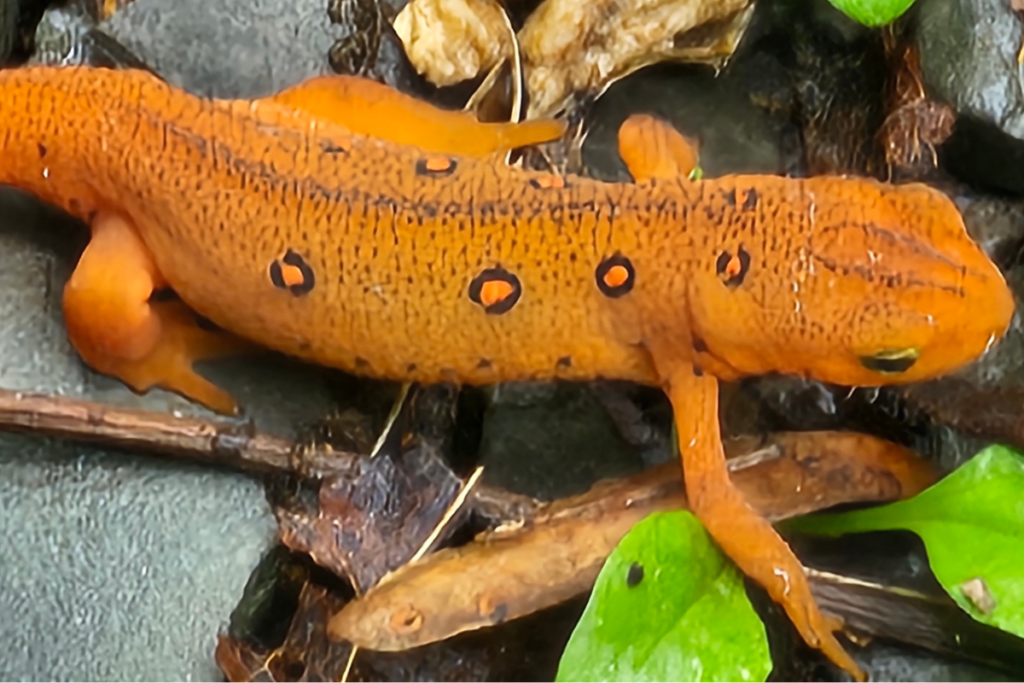
Eastern Newt (Notophthalmus viridescens) Overview – Appearance, Life Stages, and Identification Guide
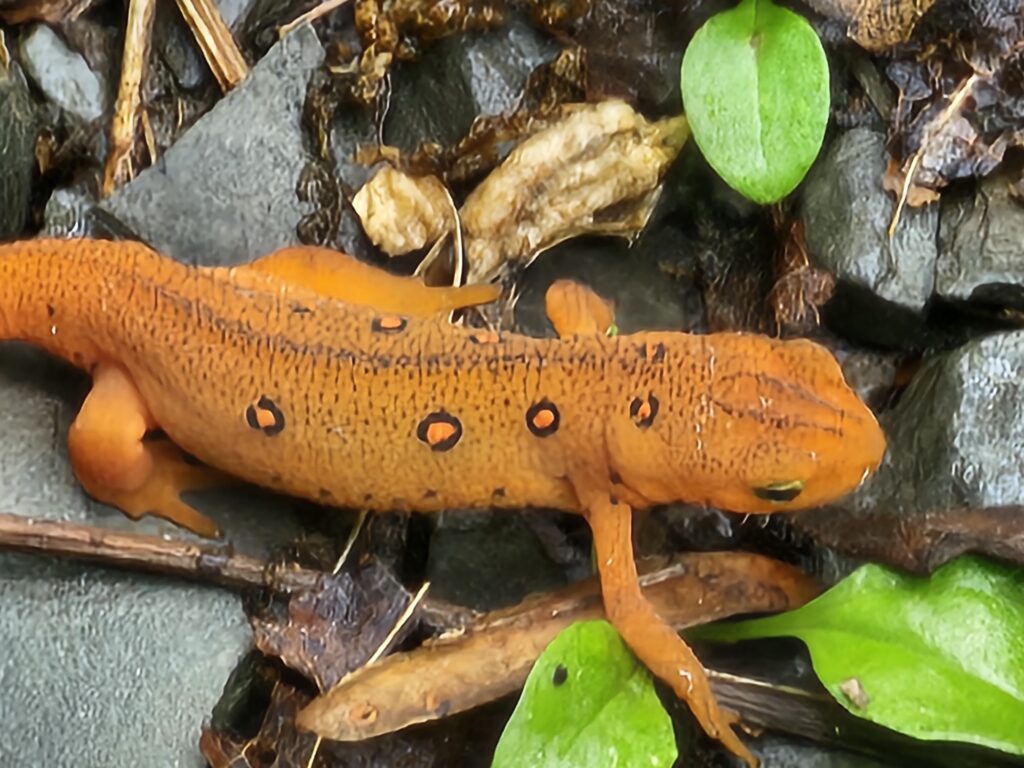
Quick Facts
Scientific Name: Notophthalmus viridescens
Common Name: Eastern Newt (Eastern North American Newt)
Location: Eastern United States and southeastern Canada
Average Size: 2.5–5 inches (6–13 cm)
Lifespan: 10–15 years
Global Range: Eastern North America
Conservation Status: Least Concern
Notable Feature: Distinct three-stage life cycle including bright orange “red eft” stage
Location Observed: Pennsylvania, USA
Field Observation
The surrounding area consisted of a shallow stream with continuously moving water and exposed rocks. Moisture levels were high, and the surfaces appeared consistently wet, providing a suitable resting location. The newt remained close to the surface of the rocks rather than hiding beneath them. This setting created a clear view of the animal in a natural, undisturbed moment.
The Eastern Newt (Notophthalmus viridescens) is a small amphibian widely recognized across eastern North America for its striking coloration and unusual development. This species stands out among salamanders due to its dramatic transformation between life stages, each with a completely different appearance. From vibrant orange juveniles to olive-toned aquatic adults, the Eastern Newt offers one of the most visually dynamic life cycles in the region.
This amphibian is commonly encountered in a variety of landscapes, from wooded regions to areas near still freshwater. Its broad geographic distribution stretches across much of the eastern United States and into parts of southeastern Canada, making it one of the most familiar salamanders for observers in these regions. Despite its small size, it often draws attention due to its bold colors and slow, deliberate movements.
In natural settings, the Eastern Newt can appear in surprisingly different forms depending on its stage of life. A person might first notice a bright orange individual walking across damp ground, only to later discover a darker, aquatic version swimming in nearby water. This contrast often leads to confusion, as many people do not initially realize these forms belong to the same species.
What makes the Eastern Newt especially interesting is how it visually represents transformation in the wild. Each stage presents a unique look and presence, allowing it to occupy different parts of its environment over time. This combination of adaptability and distinct appearance makes it a memorable and frequently documented amphibian throughout its range.
Eastern Newt Physical Appearance and Overall Form
The Eastern Newt is a small, slender amphibian with a body shape that appears slightly rounded and soft compared to more rigid reptiles. Its size typically ranges from about 2.5 to 5 inches in length, making it comparable to the length of a small finger or a short pen. Despite its compact form, it has a well-proportioned body with a defined head, short limbs, and a gradually tapering tail.
One of the most noticeable features of this species is its coloration, which can vary significantly depending on its life stage. The juvenile “red eft” stage is especially striking, displaying a bright orange or reddish body covered in distinct black-ringed spots. These spots often appear evenly spaced along the back, creating a patterned look that stands out clearly against the forest floor. In contrast, adult individuals tend to shift to more muted tones, often appearing olive green, brown, or yellowish with similar spotting.
The skin of the Eastern Newt has a slightly rough or granular texture, giving it a matte appearance rather than a glossy one. This texture can be especially visible in close-up views, where the surface appears dotted or pebbled. Unlike some salamanders that look smooth and slick, this subtle roughness helps distinguish it visually from other species.
In the wild, the Eastern Newt can look very different depending on lighting and moisture conditions. In wet environments, its colors may appear deeper and more saturated, while in drier conditions they may seem lighter or more muted. This shifting appearance, combined with its small size and bold markings, makes it both easy to recognize up close and surprisingly well blended into its surroundings from a distance.
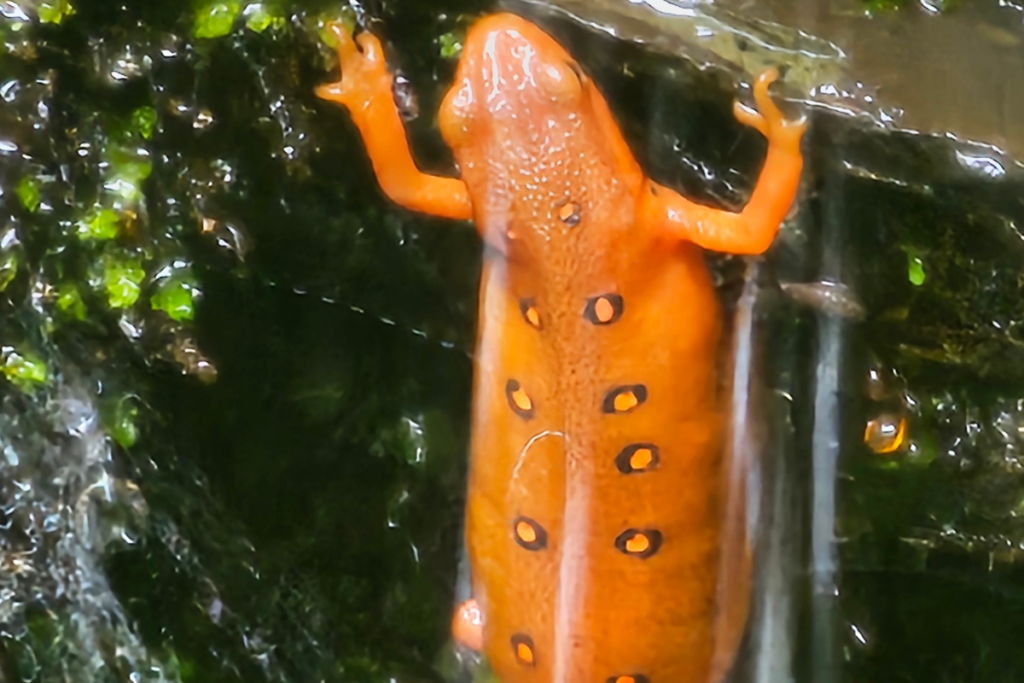
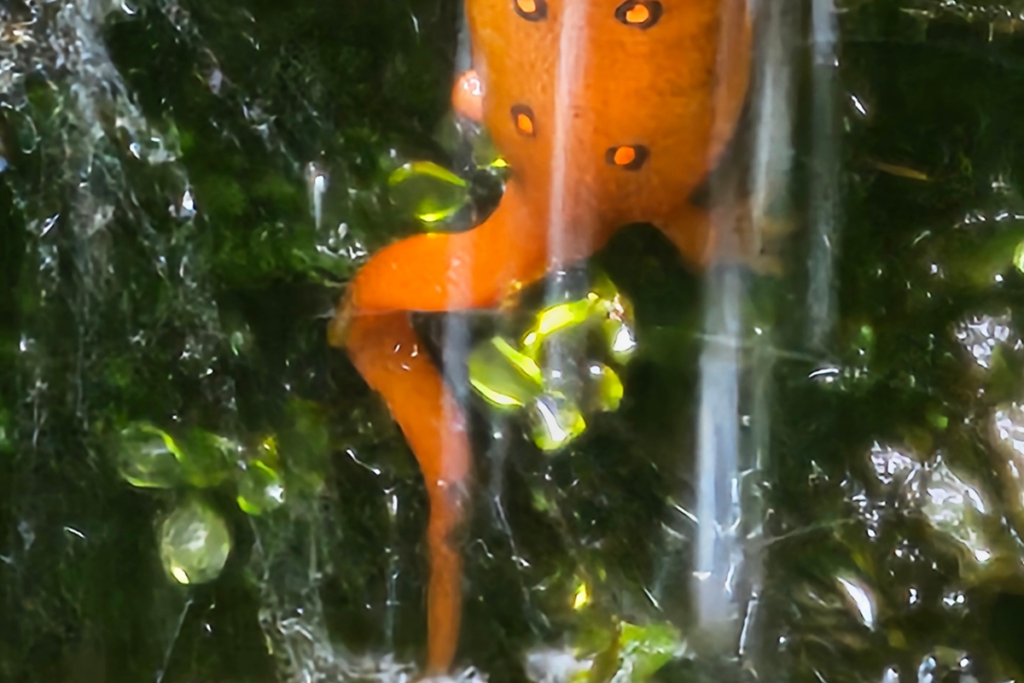
Defining Features of the Eastern North American Newt
One of the most defining characteristics of the Eastern Newt is its unique three-stage life cycle, which sets it apart from many other amphibians. While some salamanders remain similar in appearance throughout their lives, this species undergoes dramatic visual changes. Each stage is so distinct that it can resemble a completely different animal, making identification especially interesting for observers.
The bright orange juvenile stage, commonly known as the red eft, is perhaps the most recognizable form. Its vivid coloration, combined with black-ringed spots, gives it an almost painted appearance. This stage is often compared to a tiny, living ember moving slowly across the ground, making it stand out even in dense leaf litter.
As the newt matures, it transitions into a more subdued adult form with darker coloration. The body becomes less vibrant and more camouflaged, often blending into aquatic environments. Despite this shift, the characteristic spots usually remain visible, helping connect the adult appearance back to its earlier stage.
Compared to other salamanders in eastern North America, the Eastern Newt has a more robust and slightly thicker body. It lacks the elongated, extremely slender look seen in species like the red-backed salamander. Instead, its build is somewhat sturdier, giving it a compact and balanced appearance that is easy to distinguish once recognized.
Eastern Newt Role in Ecosystem and Environmental Importance
The Eastern Newt plays a valuable role in maintaining ecological balance within its range. As a small amphibian, it exists as part of a broader network of organisms that interact to keep ecosystems stable. Its presence often indicates a healthy environment, particularly in areas with clean water and intact forest systems.
Within food webs, the Eastern Newt contributes as both a consumer and a source of energy for other organisms. It helps regulate populations of smaller organisms while also serving as prey for larger animals. This dual role allows it to act as a connector between different levels of the ecosystem, supporting the overall flow of energy.
In freshwater systems, the adult stage of the Eastern Newt adds to biodiversity and helps maintain balance among aquatic life. Its presence can influence the structure of communities in ponds and slow-moving waters. These environments rely on a variety of species interacting together, and the Eastern Newt is an important part of that mix.
Beyond its direct ecological roles, the Eastern Newt is also significant as an indicator species. Because amphibians are sensitive to environmental changes, their populations can reflect the health of an ecosystem. A stable or thriving population of Eastern Newts often suggests that water quality, habitat conditions, and environmental stability are in good shape, making them an important species for understanding natural ecosystems.