Red Lionfish Overview: Identification, Range, Size, and Ecological Importance
Quick Facts
Scientific Name: Pterois volitans
Common Name: Red Lionfish
Location: Tropical and Subtropical Marine Waters
Average Size: 12–15 inches (30–38 cm)
Lifespan: 10–15 years
Global Range: Indo-Pacific (native), Western Atlantic, Caribbean, Gulf of Mexico (introduced)
Conservation Status: Not Evaluated (IUCN)
Notable Feature: Long venomous spines and striped appearance
Location Observed: Atlanta Georgia Aquarium, USA
Field Observation
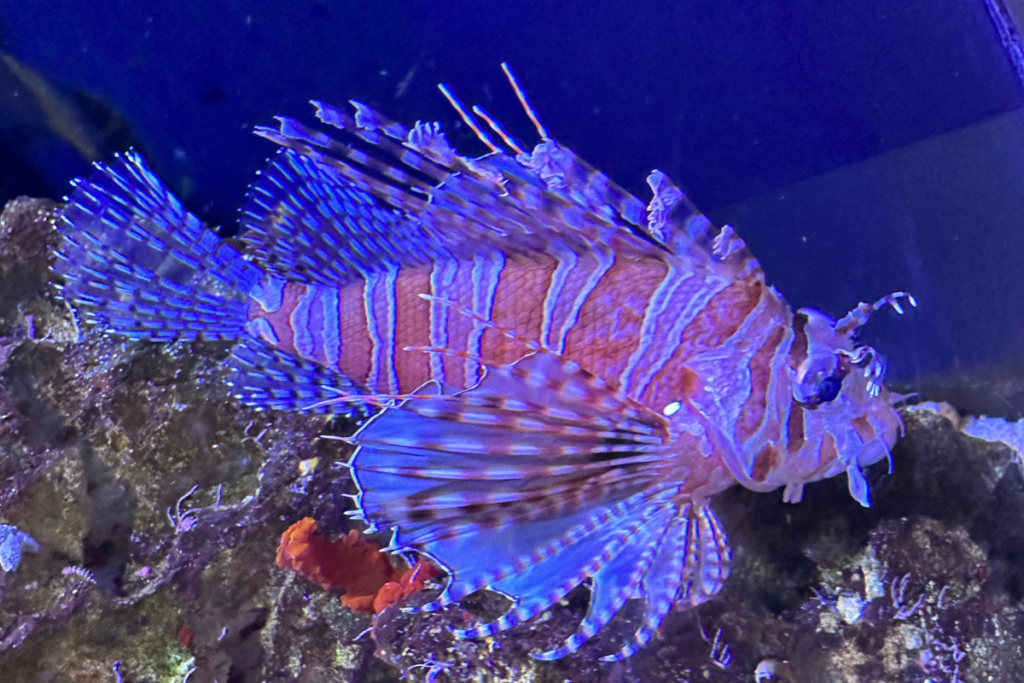
While observing this Red Lionfish, I noticed it staying close to the rocky habitat and hovering just above the structure. It remained largely motionless throughout the encounter, relying on gentle fin movements to hold its position in the water.
Red Lionfish Overview and Identification
The Red Lionfish is one of the most visually striking fish found in tropical marine ecosystems. Recognized instantly by its flowing fins, bold stripes, and dramatic silhouette, this species appears almost ornamental compared to many reef fish. Its distinctive appearance has made it one of the most photographed and recognizable fish in public aquariums around the world.
Native populations occur throughout the Indo-Pacific region, where the species inhabits warm ocean waters stretching from the Red Sea and eastern Africa to Japan, Australia, and numerous Pacific islands. Over time, the species has also become established far outside its natural range. Today, Red Lionfish are commonly encountered throughout parts of the Caribbean Sea, Gulf of Mexico, and western Atlantic Ocean.
At first glance, the fish resembles a floating fan decorated with alternating bands of red, brown, white, and cream coloration. The extended fin rays spread outward like delicate feathers, creating a shape that differs dramatically from the streamlined forms seen in many open-water fish. This unusual body design makes the species stand out even among the colorful communities found on coral reefs.
Marine enthusiasts often encounter Red Lionfish in photographs, documentaries, aquariums, and reef exhibits because of their remarkable visual appeal. Their elegant appearance attracts attention immediately, yet their popularity is matched by the ecological discussions surrounding their expansion into new regions. Whether viewed in their native range or elsewhere, they remain among the most recognizable marine fish on Earth.
Distinctive Red Lionfish Appearance and Physical Features
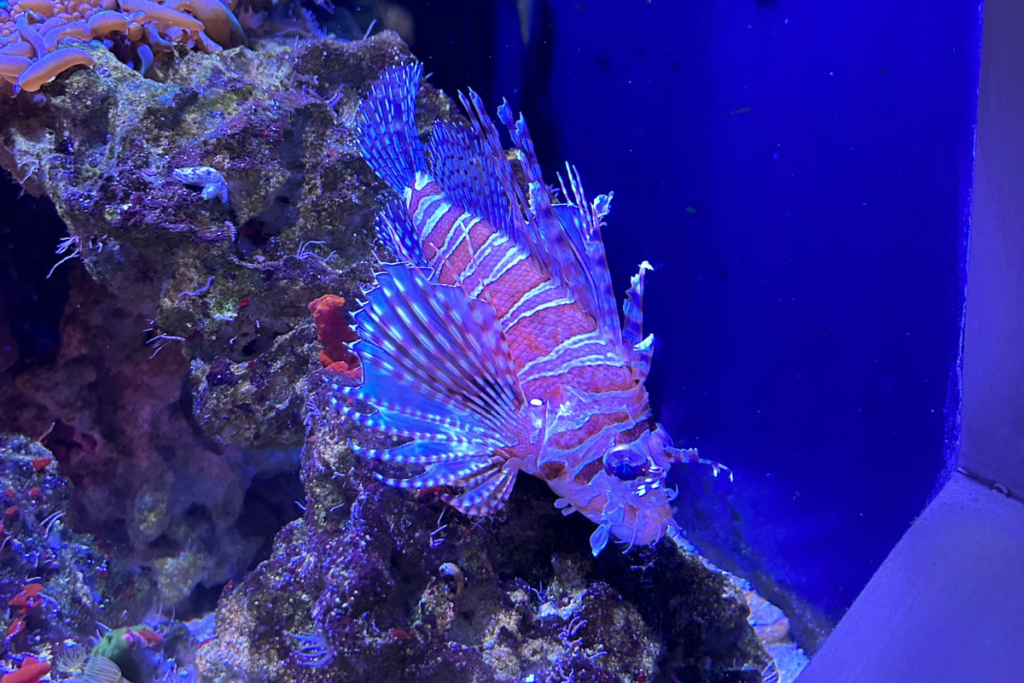
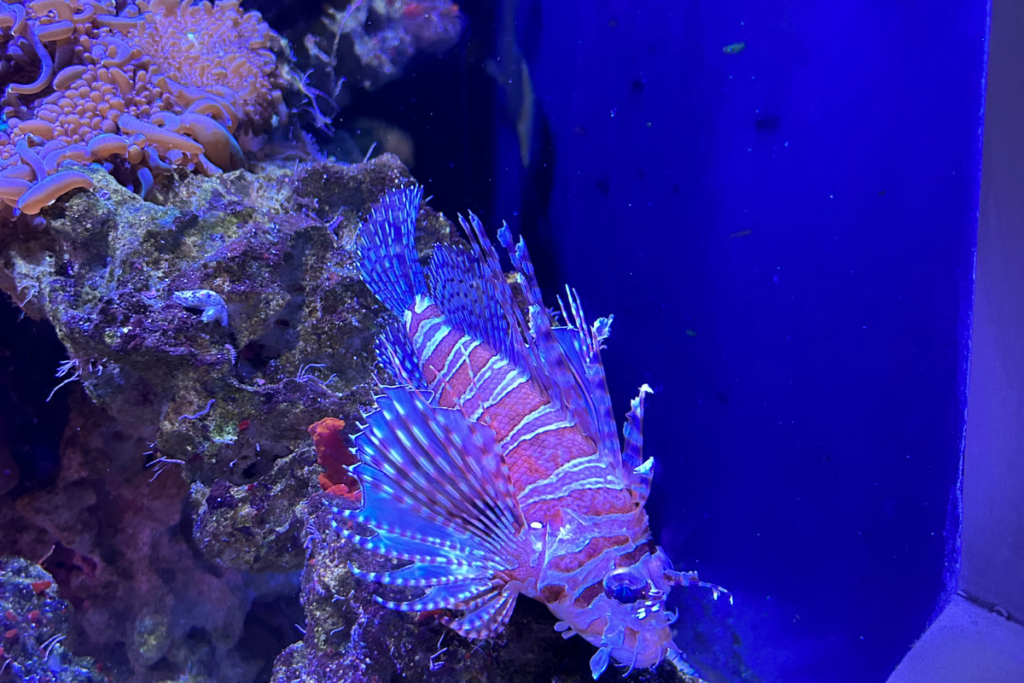
The overall appearance of the Red Lionfish is unlike almost any other fish found on coral reefs. Long dorsal spines project upward from the back while broad pectoral fins spread outward in dramatic fashion. Together, these features create a shape resembling an underwater crown or a decorative hand fan drifting through the water.
Most individuals display alternating vertical bands of reddish-brown, maroon, cream, and white. These stripes continue across the head, body, and fins, giving the fish a bold pattern visible even from considerable distances. The exact intensity of coloration can vary depending on age, location, lighting conditions, and individual genetics.
Adult Red Lionfish commonly reach lengths of 12 to 15 inches, though exceptionally large specimens may exceed 18 inches. To visualize their size, a fully grown individual is often comparable in length to a standard ruler. The broad spread of the fins can make the fish appear even larger than its actual body dimensions.
Another notable characteristic is the presence of elongated fin rays that trail behind the body like ribbons. These structures contribute to the species’ graceful appearance and help create its unmistakable profile. Even when viewed among dozens of reef fish, the Red Lionfish is often identifiable instantly because no other nearby species combines such dramatic striping with such extravagant fin structures.
Unlike many reef fish that rely primarily on bright coloration, the Red Lionfish possesses both striking colors and a uniquely shaped body. This combination of features has helped establish it as one of the most recognizable marine species worldwide.
Recognizing the Unique Characteristics of the Red Lionfish
One of the defining traits of the Red Lionfish is its array of venomous spines. These rigid structures project from the dorsal, pelvic, and anal fins and represent one of the species’ most famous identifying features. While the fish itself appears graceful and delicate, these spines provide a powerful defensive adaptation that has contributed significantly to its reputation.
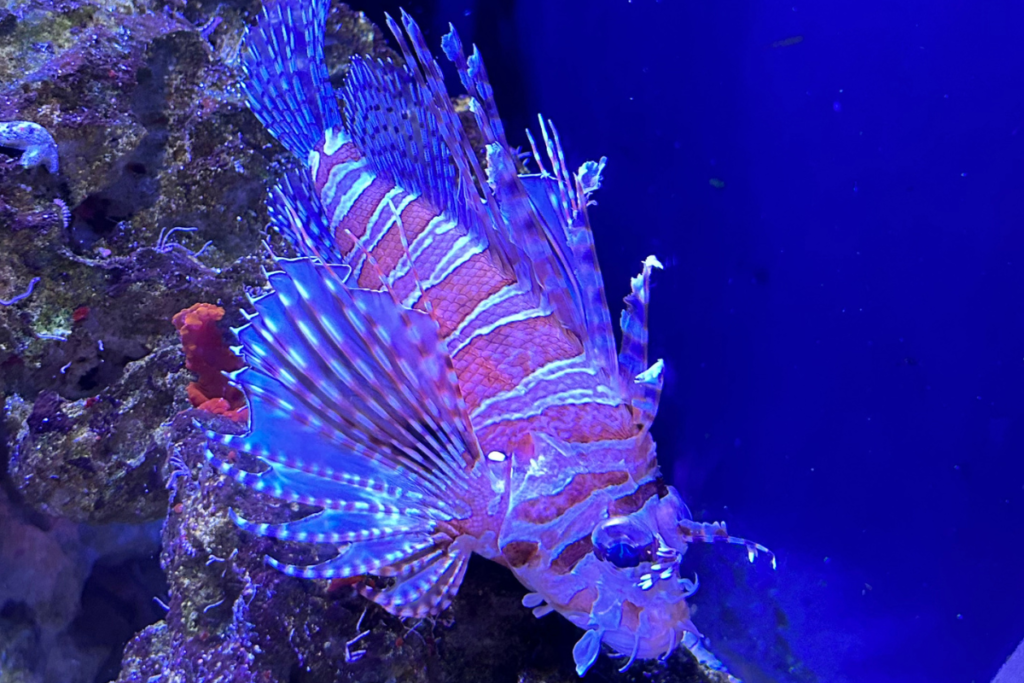
The head contains prominent ridges, fleshy appendages, and large eyes that create an almost dragon-like appearance. Viewed up close, the facial structure is surprisingly intricate. Small tentacle-like projections above the eyes add to the fish’s unusual and highly distinctive look.
Many people compare the Red Lionfish to a floating feather duster because of the way its fins radiate outward. Others liken it to an underwater peacock due to its dramatic display of colors and patterns. These comparisons help illustrate why the species stands apart from more streamlined reef fish such as tangs, wrasses, or surgeonfish.
Another remarkable characteristic is the fish’s ability to maintain its striking appearance across a wide geographic range. Whether observed in the Pacific Ocean, Indian Ocean, Caribbean Sea, or aquarium exhibits, individuals remain instantly recognizable. Few marine fish possess such a consistent visual identity across different regions.
The combination of striped coloration, venomous spines, flowing fins, and ornate facial features creates a species unlike any other. These traits have made the Red Lionfish a favorite among divers, photographers, aquarists, and marine educators seeking to highlight the diversity of life found beneath the ocean’s surface.
Red Lionfish Role Within Marine Ecosystems
Like all species, the Red Lionfish occupies an important position within marine ecosystems. As part of the broader reef community, it contributes to the complex network of relationships that help shape ocean environments. Every reef ecosystem depends upon numerous interconnected species, and the Red Lionfish represents one component of that larger ecological picture.
Within its native Indo-Pacific range, the species exists alongside a diverse array of predators, competitors, and other reef inhabitants. These long-established relationships contribute to ecological stability and help maintain balance throughout coral reef systems. The presence of Red Lionfish forms part of a natural community that has evolved together over countless generations.
In regions where the species has become established outside its native range, scientists have devoted significant attention to understanding its environmental influence. The introduction of any species into a new ecosystem can alter existing relationships and affect local biodiversity. As a result, the Red Lionfish has become one of the most studied marine fish in the western Atlantic and Caribbean.
Coral reefs support extraordinary biodiversity, providing shelter and resources for thousands of species. The Red Lionfish contributes to the overall structure of these communities through its participation in the reef food web and ecological interactions. Understanding its role helps researchers better understand how marine ecosystems function as interconnected systems rather than collections of individual species.
The species has also become important from an educational perspective. Because of its striking appearance and ecological significance, the Red Lionfish is frequently used to teach concepts involving marine conservation, invasive species management, biodiversity, and reef ecology. As a result, it serves not only as a fascinating fish but also as a valuable ambassador for ocean science and environmental awareness.
Observation Location
Observed in Atlanta Georgia Aquarium, USA
Popular Searches About Red Lionfish
Explore Red Lionfish Guide
Explore More Exhibits

Support Encounters World
Help support wildlife photography and get behind the scenes discoveries on Patreon.