Bugleweed Identification Guide: How to Recognize Leaves, Flowers, and Key Features
Quick Facts
Leaf Shape: Oval to Spoon-Shaped with Scalloped Margins
Stem Type: Square, Low-Growing Flowering Stems
Root System: Fibrous Roots with Spreading Stolons
Flower Structure: Two-Lipped Tubular Flowers in Dense Spikes
Growth Form: Creeping Groundcover
Texture: Smooth to Slightly Wrinkled
Color Variations: Green, Bronze, Burgundy, Purple, Blue, Pink, and White
Recognizing Bugleweed in the Landscape
Colorful flower spikes rising above a carpet of foliage are often the first clue that Bugleweed (Ajuga reptans) is growing nearby. This perennial groundcover has become a familiar sight in gardens, woodland borders, landscaped beds, and naturalized areas across many temperate regions. Its combination of low-growing leaves and striking blooms creates a distinctive appearance that is easy to appreciate once the plant becomes familiar.
Originally native to Europe, western Asia, and parts of North Africa, Bugleweed has spread widely through cultivation and ornamental planting. Today it appears in numerous countries where temperate climates support its growth. Because of its popularity as a groundcover, many people encounter the species long before learning its name.
The plant belongs to the mint family, a group known for square stems, opposite leaves, and unique flower structures. Several of these family characteristics are visible in Bugleweed and can help narrow identification when examining an unfamiliar plant. Observers who recognize mint-family traits often find the species easier to identify.
Although Bugleweed is common in gardens, it is occasionally confused with other creeping members of the mint family. Accurate identification depends on observing the entire plant rather than focusing on a single characteristic. Growth form, foliage, flower arrangement, and stem structure all contribute valuable clues.
Bugleweed Overall Structure and Growth Form
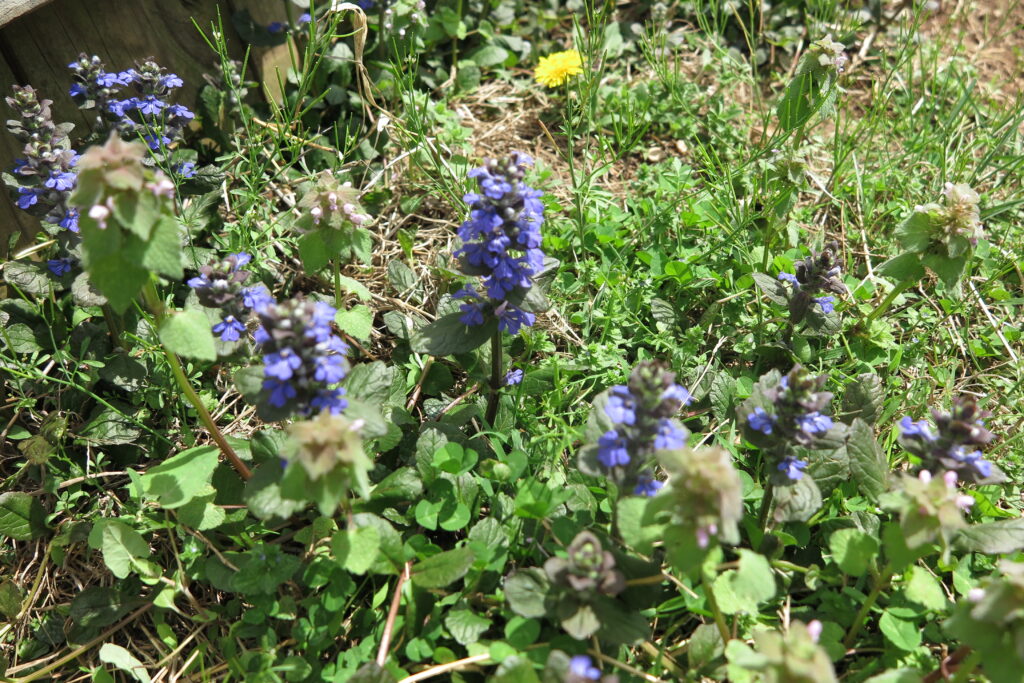
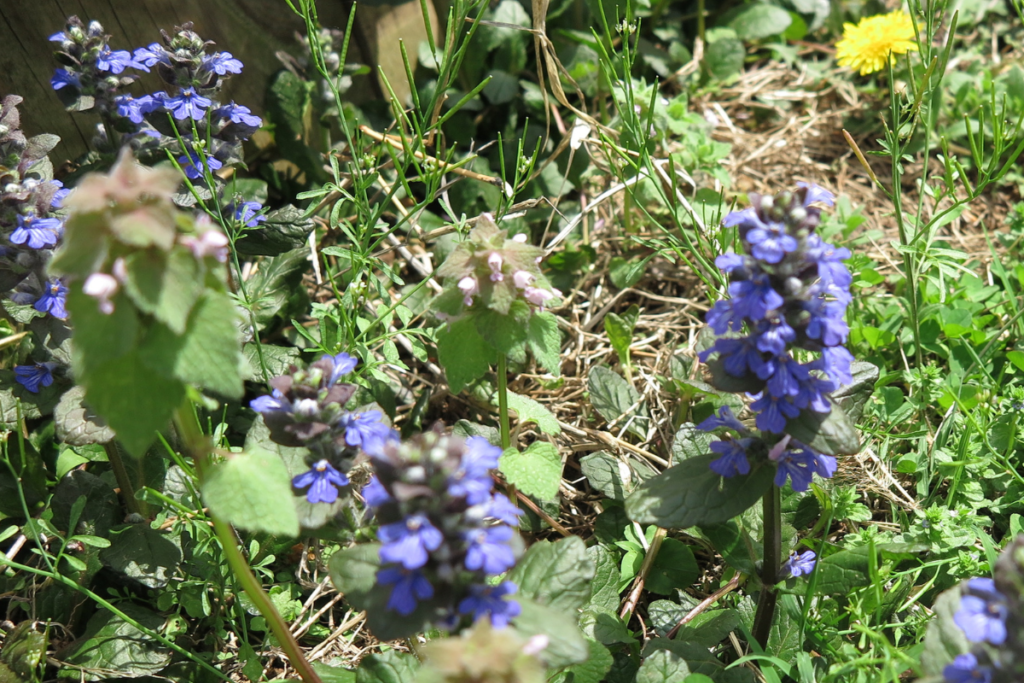
Bugleweed develops as a low-growing perennial that spreads outward across the ground rather than upward into a tall plant. Mature colonies form broad mats of vegetation that create dense coverage over the soil surface. This creeping habit is one of the most recognizable aspects of its overall appearance.
From a distance, established patches often resemble a decorative living carpet interrupted by scattered flower spikes. The foliage remains relatively close to the ground while flowering stems rise above it. This layered arrangement creates a visually appealing contrast between horizontal and vertical growth.
Most plants remain compact in height despite their ability to occupy significant horizontal space. A mature colony may spread several feet across while maintaining a low profile. This growth pattern makes the species particularly useful as a groundcover in ornamental landscapes.
A useful comparison is a blanket spread across the ground with small towers rising from its surface. The blanket represents the dense foliage layer, while the flower spikes provide the vertical accents. Few common groundcovers combine these two elements in quite the same way.
The plant’s overall shape remains relatively uniform throughout its range. Whether growing in a formal garden or a naturalized setting, Bugleweed typically maintains the same low, spreading appearance. This consistency makes overall growth form one of the most reliable identification features.
Bugleweed Leaves, Stems, and Root Structure
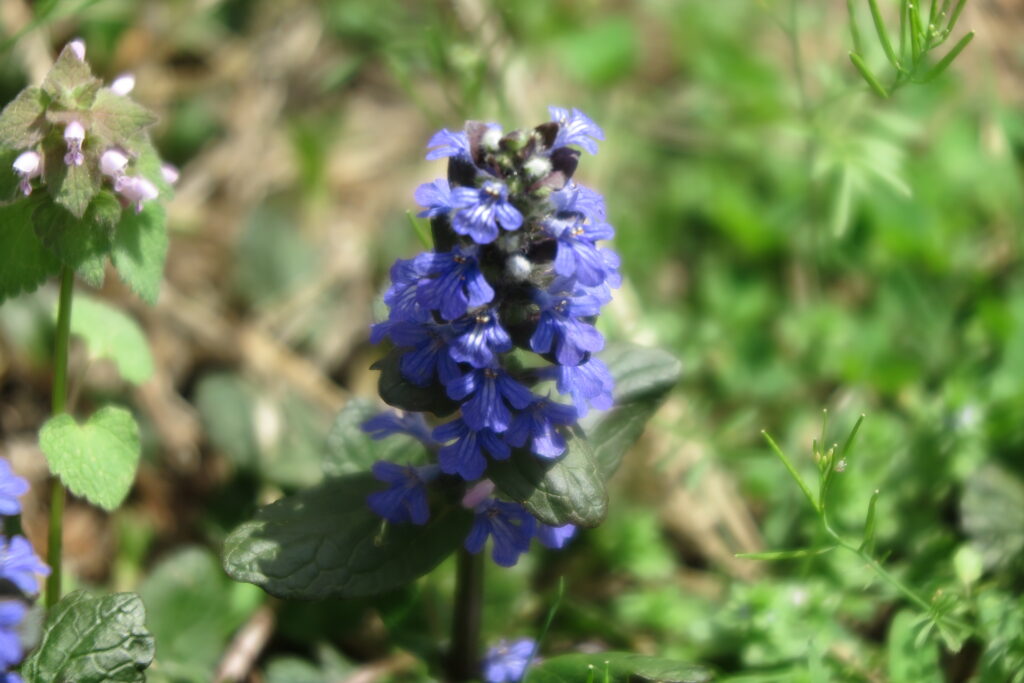
The leaves of Bugleweed are typically oval, spoon-shaped, or slightly oblong in outline. Margins often display gentle scalloping or shallow teeth that create a textured edge. These shapes help distinguish the plant from species with deeply divided or highly lobed foliage.
Leaf coloration can vary dramatically. Some plants possess bright green leaves, while others display bronze, burgundy, or deep purple tones. These color differences are especially common among cultivated varieties and contribute to the species’ popularity in ornamental gardens.
Leaves occur in opposite pairs along the stem, a classic characteristic of many mint-family plants. Looking closely at a stem often reveals two leaves positioned directly across from one another. This arrangement serves as a useful identification clue when flowers are absent.
The stems themselves are square rather than round when viewed in cross-section. A useful comparison is the difference between a pencil and a small wooden block. Running a finger along the stem often reveals distinct edges that are characteristic of mint-family species.
Below ground, Bugleweed relies on fibrous roots connected to spreading stolons. These stolons function like horizontal pathways that allow the plant to expand into surrounding space. The root system forms an interconnected network that helps create the dense colonies commonly associated with the species.
Bugleweed Flowers and Reproductive Structures
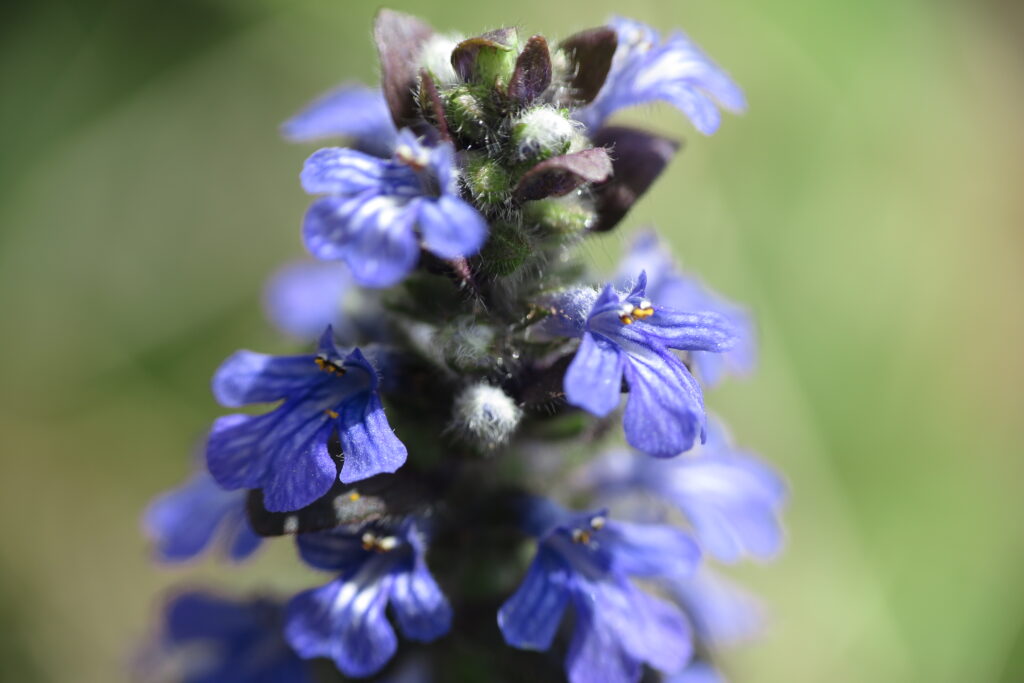
The flowers are among the easiest features to recognize. Numerous blooms are arranged in dense clusters along upright stems, forming colorful spikes that rise above the foliage. These flower spikes often become the most noticeable part of the plant during the blooming season.
Individual flowers possess a tubular structure with two distinct lips. The lower lip is typically larger and serves as a landing platform for visiting insects. This shape is common among many mint-family plants and contributes significantly to Bugleweed’s recognizable appearance.
Flower color is most often blue or violet, though pink and white forms also occur. Large colonies in bloom can create striking displays of color visible from considerable distances. These vibrant spikes often attract both pollinators and human observers.
A useful comparison is a series of miniature snapdragon-like flowers stacked vertically along a stem. Each bloom is relatively small on its own, but together they create a bold and highly visible floral display. This arrangement helps distinguish Bugleweed from plants that produce solitary flowers or loose flower clusters.
Following pollination, the plant produces small seeds that contribute to reproduction. However, the flower spikes themselves remain the most important identification feature. When combined with creeping foliage, opposite leaves, square stems, and dense groundcover growth, these reproductive structures make Bugleweed one of the easiest ornamental perennials to identify in the field.
Popular Searches About Bugleweed
Explore Bugleweed Guide
Explore More Plants

Support Encounters World
Help support wildlife photography and get behind the scenes discoveries on Patreon.