
White-Tailed Deer Scapula Fragment Overview: Features, Function, and Field Recognition

Quick Facts
Bone Type: Scapula Fragment (Shoulder Blade)
Likely Animal: White-Tailed Deer
Common Name: White-Tailed Deer Scapula Fragment
Scientific Name: Odocoileus virginianus
Bone Category: Shoulder Girdle Bone
Side of Body: Unknown
Age Class: Adult
Condition: Weathered, Fragmented
Key Identification Features: Preserved shoulder socket region, narrow scapular neck, flared blade section, broken lower edge
Size Estimate: Approximately 6–9 inches (15–23 cm) remaining length
Location Observed: Pennsylvania, USA
Field Observation
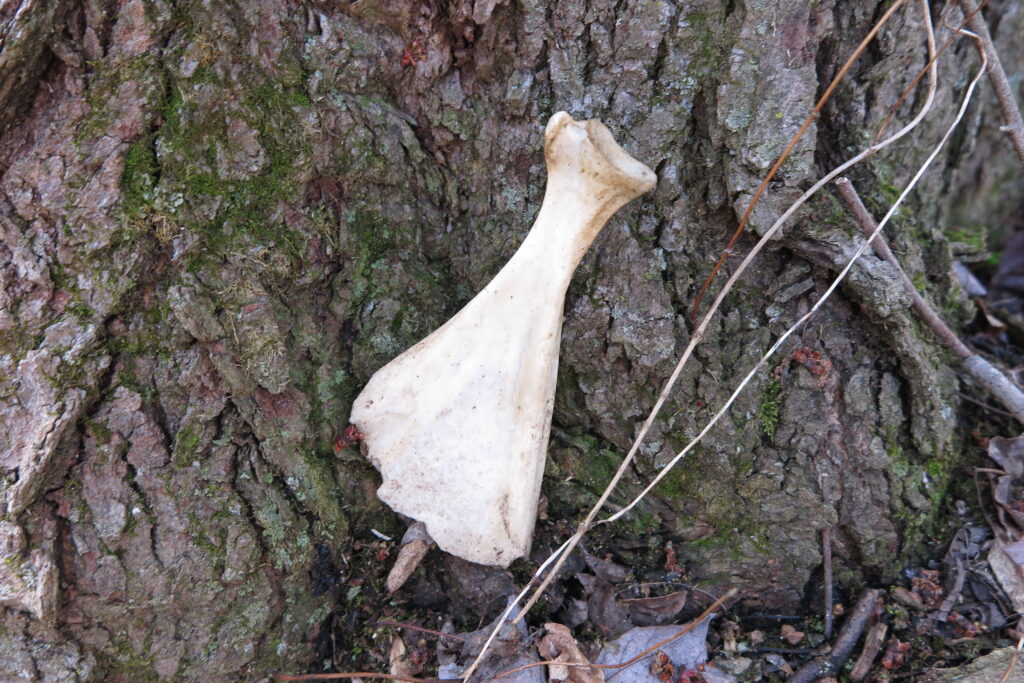
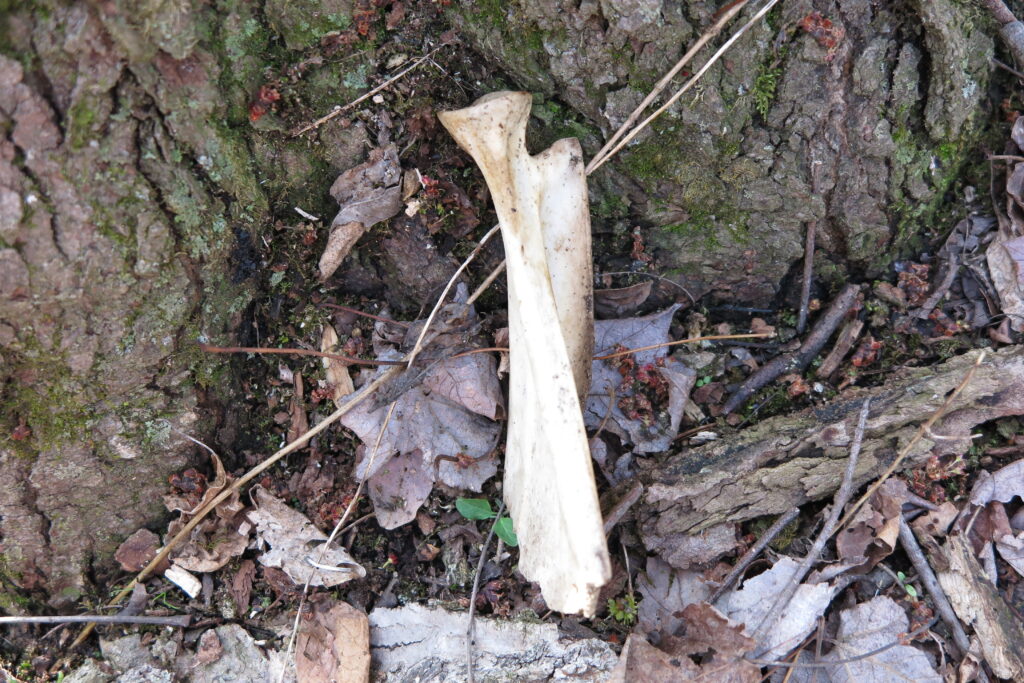
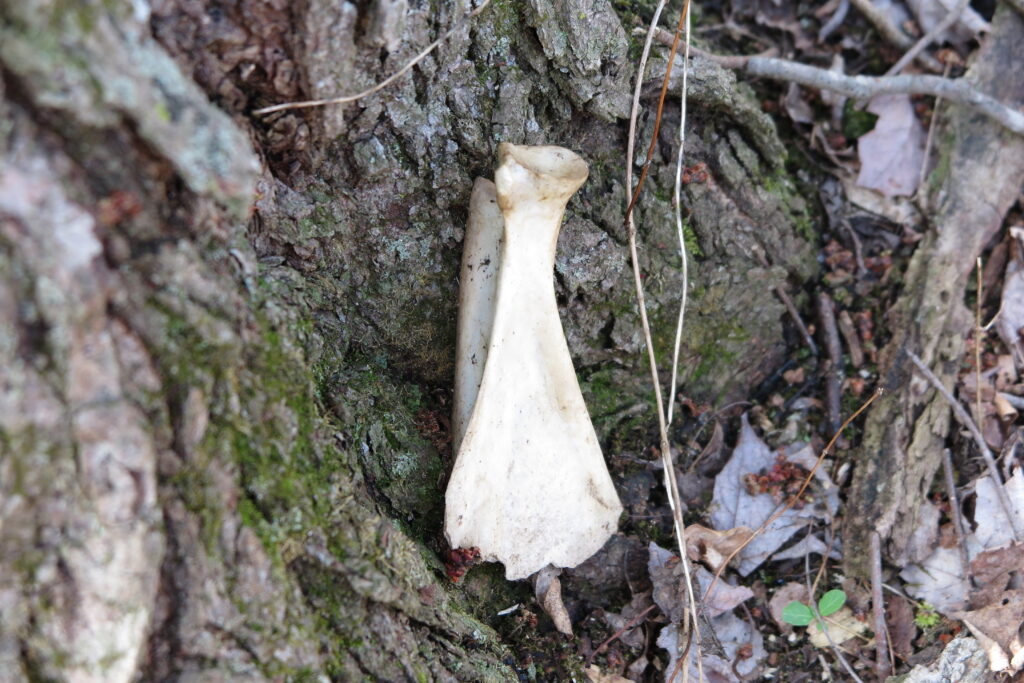
This white-tailed deer scapula fragment was found resting against the base of a tree, where it remained remarkably clean and well preserved despite outdoor exposure. The surviving shoulder socket and flared blade section retained their natural shape, making identification straightforward. Its excellent condition provided a clear view of the bone’s distinctive features and overall structure.
White-Tailed Deer Scapula Fragment Identification Overview
The bone shown here is a partial white-tailed deer scapula, commonly known as a shoulder blade. Although the lower portion of the blade has broken away, several important features remain intact, allowing the bone to be identified with confidence. Fragments like this are among the most commonly encountered deer bones found by hikers, hunters, and wildlife enthusiasts exploring natural areas.
White-tailed deer are one of the most widespread large mammals in North America. Their range extends across much of the United States, southern Canada, Mexico, Central America, and portions of South America where populations have been introduced. Because deer thrive in forests, fields, wetlands, and suburban landscapes, their skeletal remains can appear in a wide variety of environments.
Unlike complete skeletal specimens displayed in museums, bones discovered outdoors are often fragmented by weather, scavenger activity, or natural decomposition. As a result, many people encounter partial shoulder blades rather than perfectly preserved examples. Identifying these fragments requires recognizing the overall shape and surviving landmarks rather than relying on a complete bone.
This particular specimen retains the upper portion of the scapula, including the narrowed neck region and shoulder joint area. Even though the lower blade is missing, the remaining structure preserves the distinctive appearance that makes deer scapula fragments recognizable in the field. For bone collectors and wildlife observers, fragments such as this often provide valuable clues about the animals that inhabit a local area.
Recognizing a White-Tailed Deer Scapula Fragment in the Field
At first glance, this scapula fragment resembles a broad triangular plate that gradually narrows toward one end. The remaining blade section widens noticeably before tapering into the neck of the bone, creating a shape that is difficult to confuse with most long bones. This outline is often the first clue that a bone belongs to the shoulder region.
The preserved portion of the scapula appears relatively thin compared to leg bones such as the femur or humerus. Rather than having a cylindrical form, the fragment displays a flattened profile with broad surfaces and gently curved edges. These characteristics immediately separate it from weight-bearing limb bones that possess thicker shafts.
Many people compare a scapula fragment to a weathered paddle blade or a small hand shovel because of its expanding shape. The surviving section of this specimen displays a smooth transition from the narrow neck into the broader blade, creating a silhouette that remains recognizable even after breakage. This overall appearance often survives long after finer details have been lost.
Near the top of the fragment, the shoulder joint region remains visible. Although portions of the surrounding structure have weathered or broken away, the expanded end helps identify the specimen as part of the shoulder assembly rather than a rib, pelvis, or vertebra. This preserved joint area is one of the most useful identification features present on fragmented scapulae.
The bone surface appears relatively smooth, with minor staining and weathering visible throughout. Exposure to moisture, sunlight, and seasonal temperature changes has altered the original coloration, producing a pale cream appearance typical of older field-collected bones. Despite this weathering, the specimen remains structurally intact.
The broken lower edge reveals that a significant portion of the original shoulder blade is missing. Complete deer scapulae possess a much larger triangular blade than what is preserved here. However, enough of the original shape remains to demonstrate the characteristic widening pattern associated with deer shoulder bones.
Compared to many other skeletal fragments found outdoors, scapula pieces often stand out because of their unusual combination of thinness and size. The broad surface area catches light differently than surrounding debris, making the bone easier to notice among leaves, bark, and forest litter.
For wildlife identification purposes, the preserved neck region, flared blade, and shoulder joint area collectively provide strong evidence that this specimen originated from a white-tailed deer scapula. Even without the complete bone, these surviving features create a distinctive profile that experienced bone collectors can recognize quickly.
White-Tailed Deer Scapula Structure and Functional Purpose
The scapula serves as one of the most important bones within the shoulder region of a deer. Although this specimen is incomplete, the remaining sections still demonstrate the overall design that allowed the bone to perform its role during the animal’s life. The preserved neck and joint area illustrate how the shoulder connected to the front leg.
One notable characteristic of the scapula is its combination of strength and relatively low weight. The blade remains thin across much of its surface, reducing unnecessary mass while still providing enough structural support for powerful movement. This balance is particularly important for an animal that relies on speed and agility for survival.
The upper portion of the fragment contains the shoulder socket region where the front leg articulated with the body. This joint allowed a wide range of movement while maintaining stability during walking, running, and jumping. The smooth contours around the joint helped reduce friction as the leg moved through repeated motion.
Large muscles once attached across the broad surfaces of the scapula. These muscles controlled the movement of the front limbs and contributed to the powerful strides that allow white-tailed deer to sprint, leap obstacles, and maneuver through dense vegetation. The blade-like design provided ample attachment space without requiring excessive bone thickness.
Functionally, the scapula operates much like a mounting plate for the muscles of the shoulder and upper body. Instead of serving primarily as a weight-bearing column, it acts as a foundation that supports movement and force transfer. This arrangement allows the front limbs to remain both flexible and powerful.
The narrow neck preserved on this specimen represents a transition zone between the broad blade and the shoulder joint. During movement, forces generated by the leg traveled through this region and were distributed across the larger surface area of the scapula. This design helped prevent stress from concentrating in a single location.
The broad blade can be compared to a lightweight support panel. It provides a large area for muscle attachment while maintaining a relatively thin structure. This efficient design is commonly seen in fast-moving mammals that depend on mobility rather than brute strength alone.
Even as a fragment, this specimen demonstrates the remarkable engineering of the deer shoulder. The combination of a broad blade, reinforced neck, and durable joint region created a structure capable of supporting years of continuous movement across forests, fields, and uneven terrain.
Where White-Tailed Deer Scapula Fragments Are Commonly Found
White-tailed deer scapula fragments are frequently encountered in wooded environments where deer populations are abundant. Forest floors often accumulate skeletal remains over time, especially in areas where natural decomposition occurs away from human activity. Leaves, fallen branches, and vegetation may partially conceal bones for months or even years.
Field edges and transitional habitats also produce many deer bone discoveries. These locations are heavily used by deer traveling between feeding and bedding areas. As carcasses decompose naturally, individual skeletal elements gradually become scattered throughout the surrounding landscape.
Scavengers play a significant role in determining where scapula fragments eventually appear. Coyotes, foxes, vultures, raccoons, and other animals commonly move bones away from the original carcass location. A shoulder blade fragment discovered beside a trail may have originated from an animal that died hundreds of yards away.
Waterways are another common source of skeletal finds. Heavy rain, seasonal flooding, and erosion can expose bones that were previously buried beneath soil or vegetation. Streams occasionally transport skeletal elements short distances before depositing them along banks, gravel bars, or exposed shorelines.
A real-world example might involve a deer that dies within a remote forest. Over time, scavengers remove soft tissue while weather gradually breaks down the skeleton. Individual bones become dispersed, and a scapula fragment such as this one may eventually remain exposed beside a tree base while other skeletal elements stay hidden nearby.
Forest trails often reveal bones after seasonal changes. During autumn and winter, reduced vegetation makes skeletal remains easier to spot. Spring rainfall can further expose fragments by washing away leaf litter that accumulated during previous seasons.
Weathering patterns frequently provide clues about how long a bone has been present. Pale coloration, surface cracking, and slight staining often indicate prolonged exposure to outdoor conditions. The specimen shown here exhibits moderate weathering consistent with a bone that has remained in a natural environment for an extended period.
Whether discovered beneath a large tree, along a hiking trail, beside a creek, or in an open woodland clearing, a white-tailed deer scapula fragment offers valuable evidence of local wildlife activity. Its distinctive shape and durable structure make it one of the more recognizable deer bone fragments encountered during field exploration and bone identification.
Observation Location
Observed in Nixon Park Nature Center, Pennsylvania, USA
Popular Searches About Deer Scapula
Explore Deer Scapula Guide
Explore More Bones

Support Encounters World
Help support wildlife photography and get behind the scenes discoveries on Patreon.