
Buffalo Treehopper vs Thorn Bug: How to Tell These Thorn-Like Insects Apart
Quick Facts
Buffalo Treehopper Size: 6–10 mm
Thorn Bug Size: 10–18 mm
Buffalo Treehopper Shape: Broad triangular profile
Thorn Bug Shape: Long, extended horn projection
Shared Family: Treehoppers (Membracidae)
Best Identification Feature: Shape of the pronotum
Buffalo Treehopper and Thorn Bug Identification Overview
The Buffalo Treehopper (Stictocephala bisonia) and the Thorn Bug (Umbonia crassicornis) are two of the most unusual insects within the treehopper family. Their bizarre body shapes often cause confusion because both species resemble thorns, plant growths, or sharp projections attached to stems. Despite these similarities, several important differences make identification possible.
Both insects belong to the Membracidae family, a group known for enlarged pronotums that create unusual shapes and silhouettes. These modified body structures help treehoppers blend into vegetation and avoid predators. Their strange appearances have made them some of the most recognizable insects in North America.
People frequently encounter Buffalo Treehoppers in northern and temperate regions, while Thorn Bugs are more commonly associated with warmer climates. Photographs shared online often lead to confusion because both species possess horn-like projections and green coloration.
At first glance, the two insects may appear closely related, much like comparing a deer and an antelope. However, closer examination reveals differences in body structure, size, coloration, and geographic range. Understanding these distinctions makes field identification much easier.
Buffalo Treehopper vs Thorn Bug Appearance
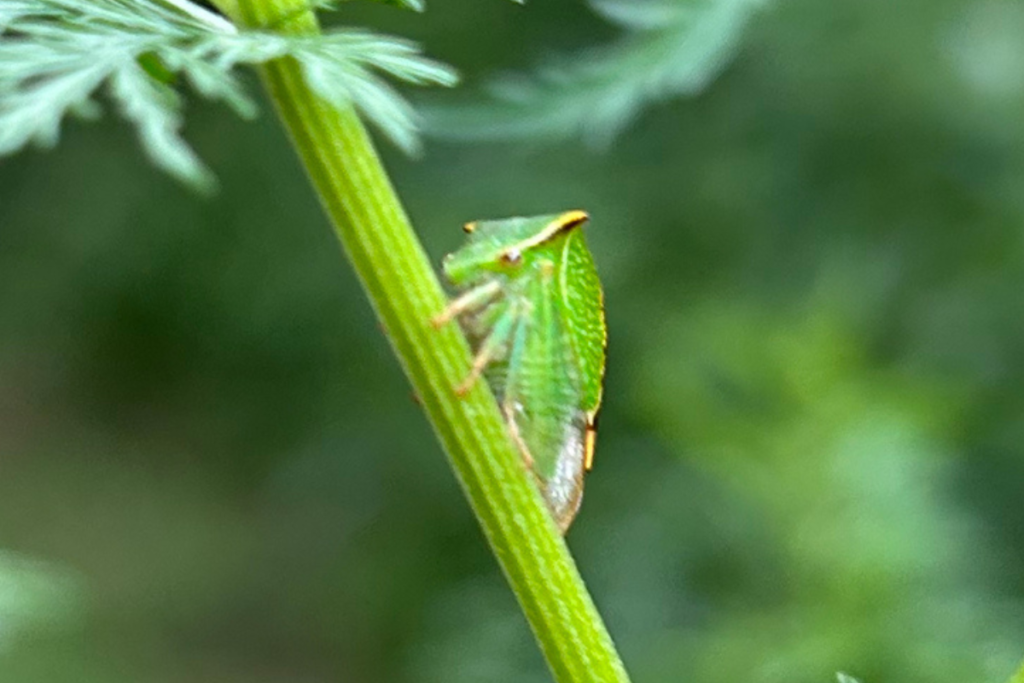
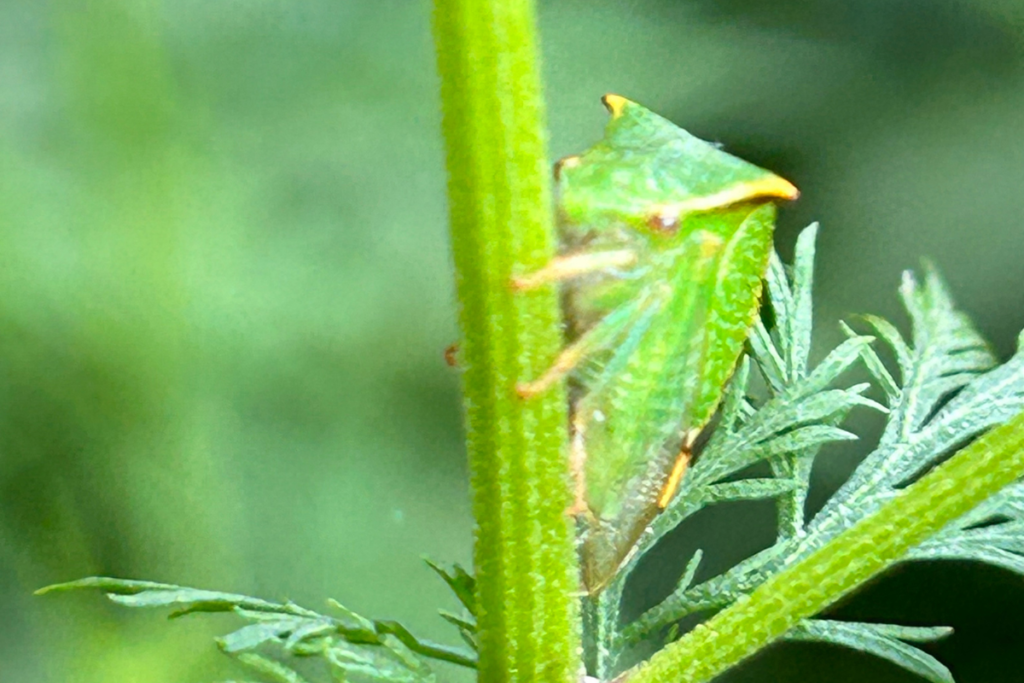
The Buffalo Treehopper possesses a broad triangular body that resembles the shoulders of a buffalo. Its pronotum rises upward into two angled points, creating a compact and symmetrical shape. The overall profile appears smooth and balanced.
The Thorn Bug develops a much taller and narrower projection. Instead of broad shoulders, the pronotum extends into a long spine that projects upward and backward from the body. This horn-like extension gives the insect a more dramatic appearance.
Buffalo Treehoppers typically measure between 6 and 10 millimeters long. Thorn Bugs are often considerably larger, reaching lengths of 10 to 18 millimeters. The larger size makes Thorn Bugs easier to notice in the field.
Coloration can overlap between the two species. Both may appear green, yellow-green, or slightly brown. However, Thorn Bugs frequently display more variation and may possess colorful markings, orange highlights, or darker areas.
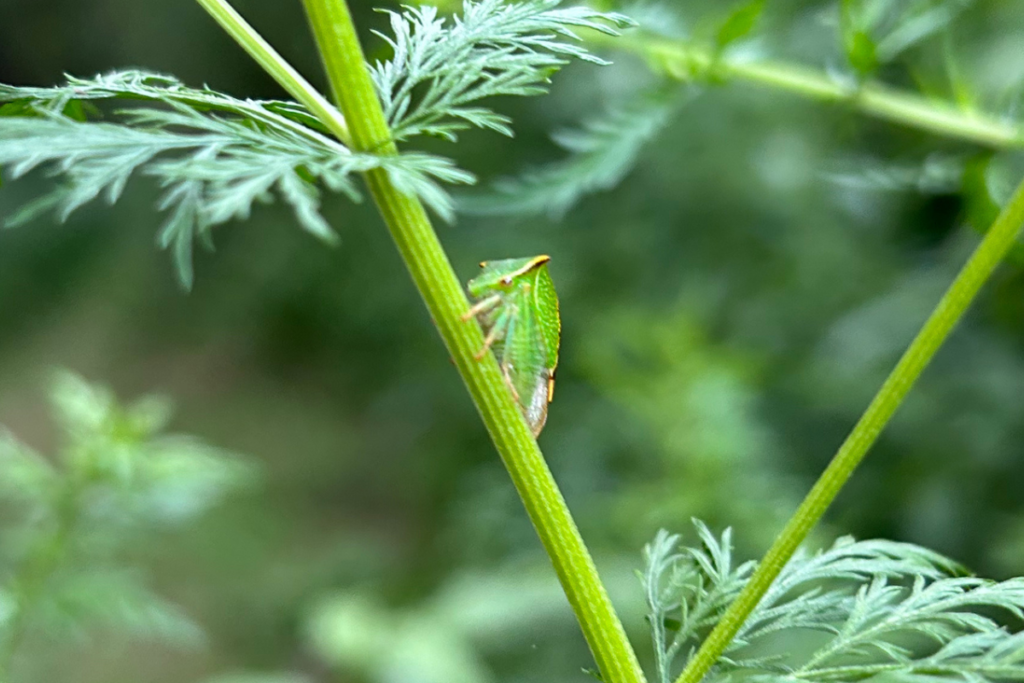
Viewed from the side, Buffalo Treehoppers resemble a small thorn or folded plant bud. Thorn Bugs look more like a sharp spike or elongated horn. The difference in silhouette remains one of the easiest identification features.
The Buffalo Treehopper appears compact and somewhat rounded, while the Thorn Bug has a taller and more exaggerated profile. Their body shapes represent two different approaches to camouflage within the same insect family.
Geographic Range and Distribution Differences
Buffalo Treehoppers occur throughout much of North America. Their range extends across southern Canada, the United States, and portions of Mexico. Introduced populations have also become established in parts of Europe.
Thorn Bugs primarily inhabit warmer regions. They are commonly found in Florida, Central America, South America, Mexico, and portions of the southern United States. Their distribution favors subtropical and tropical climates.
A treehopper discovered in Pennsylvania, New York, Michigan, or Canada is far more likely to be a Buffalo Treehopper than a Thorn Bug. The northern distribution of Buffalo Treehoppers makes them the common thorn-shaped treehopper in much of the United States.
Thorn Bugs become increasingly common farther south. Florida, Texas, and tropical regions support larger populations because the warm climate suits their life cycle. Many observations from Central America involve Thorn Bugs rather than Buffalo Treehoppers.
Climate preferences help separate the two species. Buffalo Treehoppers tolerate cold winters and seasonal climates, while Thorn Bugs generally occur where freezing temperatures are uncommon.
Location alone cannot guarantee identification, but geography provides an important clue. Understanding the normal range of each species often helps eliminate confusion before examining physical features.
Identifying Buffalo Treehoppers and Thorn Bugs in the Field
The easiest way to distinguish these insects is by examining the shape of the pronotum. Buffalo Treehoppers display broad, angled shoulders that create a buffalo-like appearance. Thorn Bugs possess a long, pointed spine that extends dramatically above the body.
Size provides another useful clue. If the insect appears very small, roughly the size of a pea, it is often a Buffalo Treehopper. Larger individuals with taller projections may indicate a Thorn Bug.
Photographs taken from the side are especially useful for identification. The side profile reveals the overall body shape and allows the pronotum to be examined clearly. Top-down photographs may hide important differences.
Both insects share similar camouflage strategies. They remain motionless on stems, rely on plant-like shapes, and avoid detection by predators. Their behaviors often appear nearly identical despite differences in appearance.
For beginning naturalists, the Buffalo Treehopper can be compared to a tiny green buffalo standing on a stem. The Thorn Bug resembles a sharp thorn or spike growing directly from the plant. This simple comparison often helps observers remember the distinction.
Although these insects belong to the same family, they possess unique body structures adapted to different environments and evolutionary histories. Learning to identify them provides an excellent introduction to the remarkable diversity found within treehoppers.
Once the differences become familiar, Buffalo Treehoppers and Thorn Bugs are surprisingly easy to separate. Their distinctive shapes make them two of the most memorable insects encountered in gardens, forests, and natural areas.
Popular Searches About Buffalo Treehoppers
Explore Buffalo Treehopper Guide
Explore More Wildlife

Support Encounters World
Help support wildlife photography and get behind the scenes discoveries on Patreon.