
Blacklet Fly vs Hoverfly Guide: How to Tell the Difference Between Blacklet Flies and Hoverflies
Quick Facts
Comparison Type: Fly Family Identification
Blacklet Fly Family: Heleomyzidae
Hoverfly Family: Syrphidae
Most Noticeable Difference: Hoverflies often mimic bees and wasps, while blacklet flies usually have darker, simpler coloration
Average Blacklet Fly Size: 4–12 mm (0.15–0.47 in)
Average Hoverfly Size: 5–20 mm (0.19–0.78 in)
Identification Difficulty: Moderate
Best Feature to Examine: Body coloration, shape, and overall appearance
Blacklet Fly vs Hoverfly Identification Overview
Blacklet flies and hoverflies are two groups of true flies that are commonly observed around flowers, vegetation, and natural landscapes. Because both belong to the order Diptera and often visit similar locations, they are frequently confused with one another. At a quick glance, many observers assume they are seeing the same type of insect.
The confusion becomes even more understandable when both insects are photographed from a distance. Each possesses large compound eyes, a single pair of wings, and a compact body structure. Without careful observation, distinguishing between the two can be challenging.
Blacklet flies belong to the family Heleomyzidae, while hoverflies belong to the family Syrphidae. Although they share certain fly characteristics, they evolved separately and display noticeably different appearances when examined closely. These differences become easier to recognize once key identification features are understood.
Learning to separate blacklet flies from hoverflies improves insect identification skills and helps observers better understand local biodiversity. Instead of labeling every flower-visiting fly as a hoverfly, naturalists can begin recognizing the unique traits associated with each family.
Blacklet Fly and Hoverfly Appearance Comparison
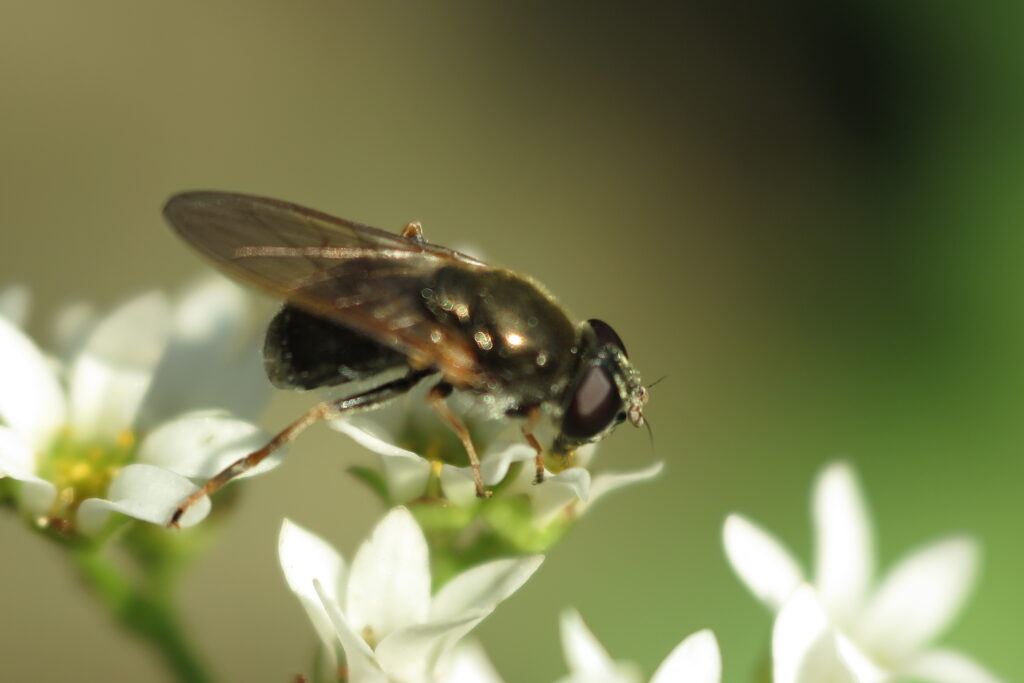
The easiest way to distinguish these insects is by examining overall appearance. Blacklet flies usually display dark coloration ranging from brown and charcoal gray to nearly black. Their bodies often appear plain and understated without strong visual markings.
Hoverflies are frequently much more colorful. Many species possess bright yellow, orange, white, or black patterns arranged in bands across the abdomen. These markings often resemble bees or wasps and create one of the most recognizable features of the Syrphidae family.
Body shape also differs noticeably. Blacklet flies often appear slender and streamlined with a narrow profile. Hoverflies are commonly broader and more robust, particularly species that mimic bumblebees or honey bees.
The abdomen provides another useful clue. In blacklet flies, the abdomen is typically elongated and simple in appearance. Hoverflies frequently display contrasting color bands that immediately draw attention.
Wing appearance can help support identification. Blacklet flies often possess clear to slightly smoky wings that blend naturally with their dark body coloration. Hoverfly wings are usually transparent but may stand out more because of the brighter body colors surrounding them.
Head structure shares similarities because both groups are flies. Large compound eyes dominate much of the head in both families. However, hoverflies often appear more rounded and bee-like overall, while blacklet flies tend to maintain a more straightforward fly-like profile.
A useful comparison is to imagine two cars parked side by side. One vehicle features bright paint, decorative trim, and bold styling, while the other has a simple dark finish and minimal decoration. Hoverflies resemble the more visually striking vehicle, while blacklet flies resemble the simpler design.
For most observers, body coloration remains the fastest identification method. Bright yellow bands generally suggest a hoverfly, while a uniformly dark insect is more likely to be a blacklet fly or another non-hoverfly species.

Key Identification Features That Separate Blacklet Flies and Hoverflies
One of the defining traits of hoverflies is their tendency to mimic stinging insects. Many species evolved color patterns that resemble bees, wasps, or hornets. This mimicry helps discourage predators even though hoverflies themselves are harmless.
Blacklet flies generally do not rely on visual mimicry. Their appearance is often based on camouflage and subtle coloration rather than warning patterns. This creates a much different overall impression when viewed in the field.
The thorax of a blacklet fly often appears glossy and dark with only slight color variation. Hoverflies frequently display more noticeable contrasts between different body regions. These differences can often be observed even without magnification.
Leg appearance may also differ. Many hoverflies possess legs that contribute to their bee-like appearance, while blacklet flies usually maintain a simpler and less conspicuous structure. The result is a more understated silhouette.
Another distinguishing feature involves overall body proportions. Hoverflies often appear compact and sturdy, particularly larger species. Blacklet flies frequently look narrower and more elongated, creating a distinctly different shape.
Observers sometimes mistake dark-colored hoverflies for blacklet flies. In these situations, examining body markings becomes especially important. Even darker hoverflies often retain subtle patterning or structural characteristics associated with Syrphidae.
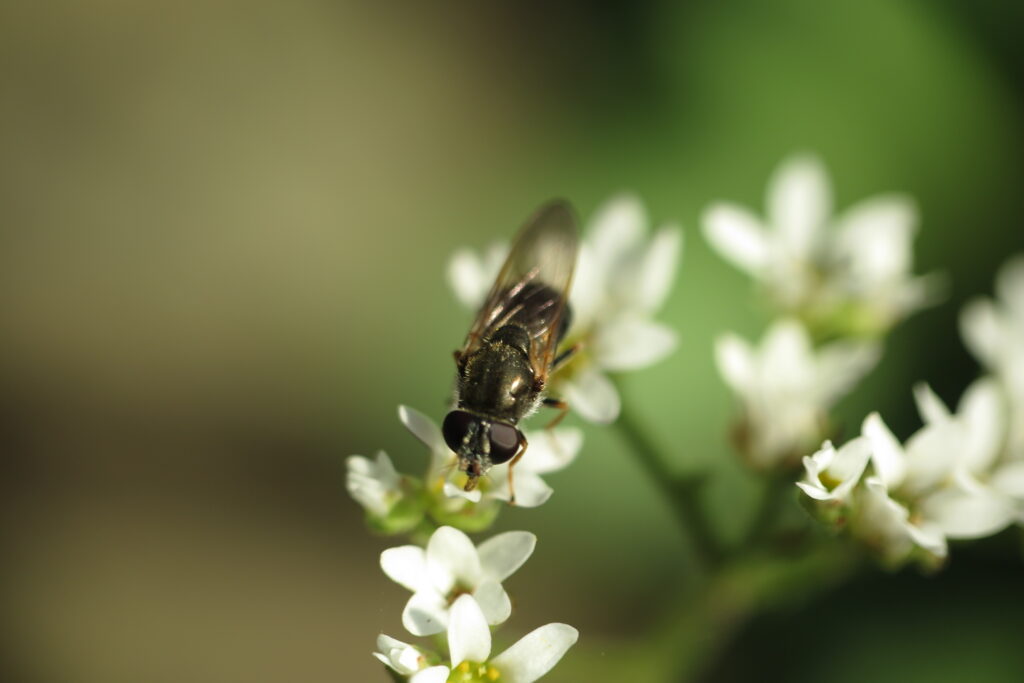
Photographs can reveal additional differences. When viewed through macro images, hoverflies often display more prominent facial features and colorful abdominal markings. Blacklet flies generally maintain a cleaner, darker appearance with fewer obvious visual highlights.
Successful identification rarely depends on a single feature. Instead, combining body shape, coloration, markings, and overall appearance provides the most reliable way to distinguish between blacklet flies and hoverflies.
Ecological Roles of Blacklet Flies and Hoverflies
Although these insects may appear similar, they occupy somewhat different ecological roles. Both contribute to biodiversity and form part of larger insect communities, but their environmental importance often differs in emphasis.
Hoverflies are widely recognized as important pollinators. Many species visit flowers regularly and contribute to pollen transfer between plants. Because of this, they are frequently highlighted in discussions about pollinator conservation.
Blacklet flies also interact with flowering plants but are generally less famous for pollination. Their ecological significance often extends into other environmental processes that support ecosystem function. These contributions are valuable even if they receive less public attention.
Both groups serve as food for birds, spiders, amphibians, reptiles, and predatory insects. Their presence helps transfer energy through natural food webs. Without numerous small insects such as flies, many larger animals would lose an important food source.
A useful comparison can be made to different positions on a sports team. Both players contribute to overall success, but each performs a slightly different role. Blacklet flies and hoverflies function similarly within ecosystems, supporting environmental health in complementary ways.
Hoverflies are often easier for casual observers to notice because of their bright colors. Blacklet flies, in contrast, frequently go unnoticed despite being widespread and ecologically important. This difference in visibility sometimes creates the false impression that hoverflies are more common.
Accurate identification helps reveal the diversity hidden among flower-visiting insects. Many insects initially labeled as hoverflies belong to entirely different fly families. Recognizing these distinctions provides a more complete understanding of local wildlife.
Ultimately, blacklet flies and hoverflies share certain similarities but remain distinct groups with unique appearances and ecological roles. Learning the differences between them transforms a simple insect observation into a deeper appreciation of the remarkable diversity found within the world of flies.

Popular Searches About Blacklet Flies
Explore Blacklet Fly Guide
Explore More Wildlife

Support Encounters World
Help support wildlife photography and get behind the scenes discoveries on Patreon.