Why Are Ants Moving Their Eggs? (Inside Ant Colony Relocation Behavior)
Quick Facts
Location: Soil, gardens, forests, and open ground
Average Size: 4–7 mm (about the size of a sesame seed)
Lifespan: Workers: months to over a year; Queens: multiple years
Global Range: North America, Europe, and parts of Asia
Conservation Status: Not Evaluated (common and widespread)
Notable Feature: Rapidly carries white brood (larvae and pupae) during colony disturbance or relocation
Introduction to Why Ants Move Their Eggs in the Wild
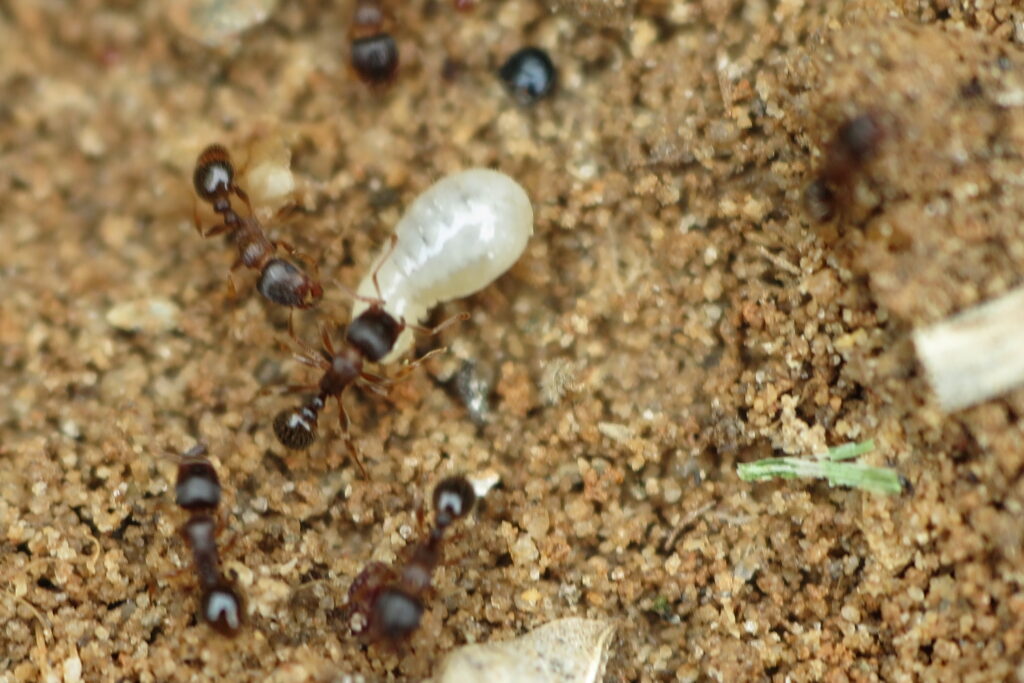
Ants are among the most organized insects in the natural world, and one of the most noticeable behaviors people observe is when they carry small white objects across the ground. This activity often happens suddenly, usually after the soil has been disturbed or a hidden colony has been exposed. The movement appears fast, purposeful, and highly coordinated, drawing immediate attention.
Red ants in the genus Myrmica are commonly seen displaying this behavior throughout temperate regions of North America, Europe, and Asia. They frequently inhabit areas where soil can be easily uncovered, such as trails, gardens, and forest edges. When these environments are disrupted, their otherwise hidden activity becomes visible on the surface.
The white objects being moved are typically mistaken for eggs, but they are more often larvae and pupae—key stages in the ant’s life cycle. These stages are larger and easier to transport, making them the most visible during relocation. Their bright color contrasts sharply with the surrounding soil, making the behavior even more noticeable.
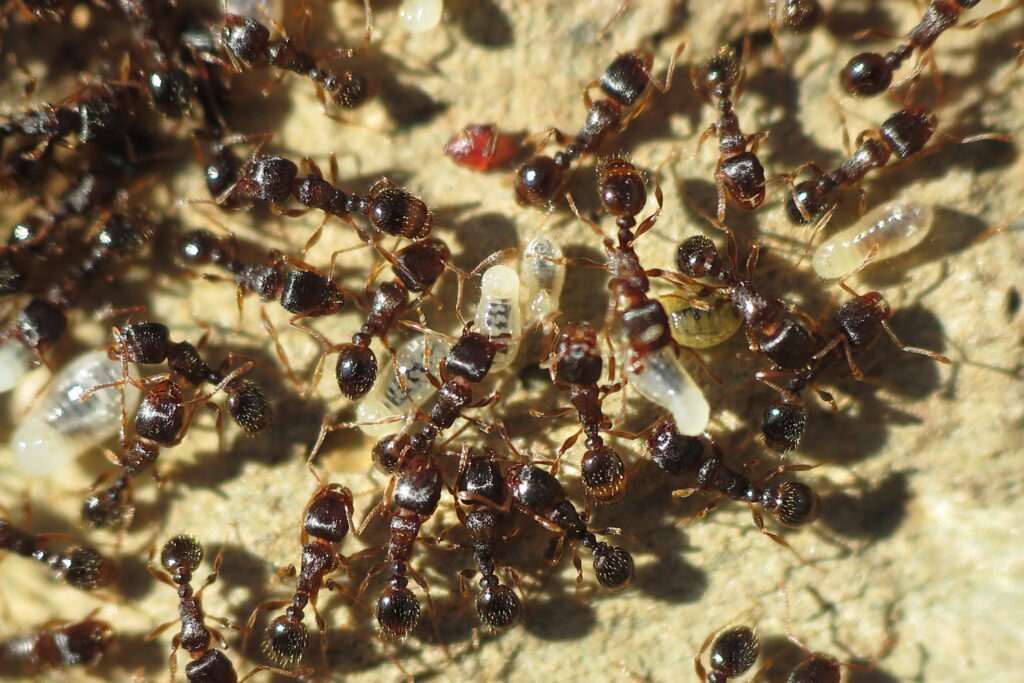
What may seem like a chaotic reaction is actually a highly organized process. Within seconds, multiple ants begin moving these developing individuals toward safer locations. This brief moment offers a rare and revealing look into how ant colonies respond when their underground systems are exposed.
What Ants Carry During Relocation – Appearance and Identification of Brood
The white forms carried by ants during relocation are part of their developing brood, which includes larvae and pupae. Larvae appear soft and curved, resembling tiny grains of rice, while pupae are slightly more solid and oval-shaped. Both stages are larger than eggs and are the primary forms moved during surface activity.
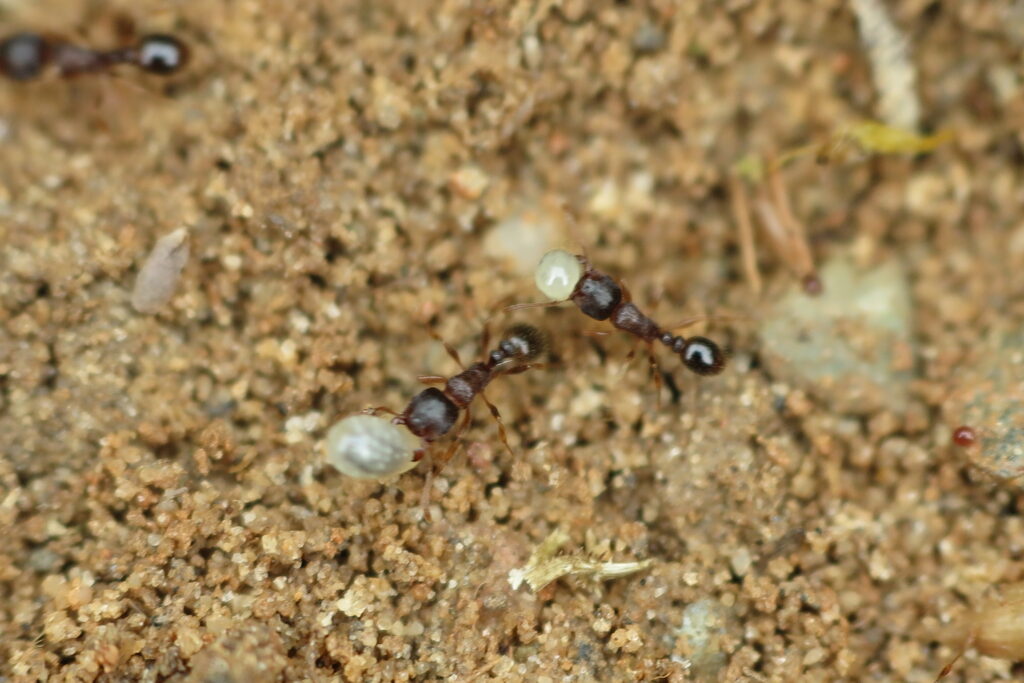
In Myrmica ants, these brood stages are clearly visible when exposed, often carried individually by worker ants. Their pale coloration ranges from bright white to a faint cream tone, making them stand out against darker backgrounds. This contrast makes it easy to spot them even when movement is rapid.
Eggs, by comparison, are much smaller and rarely seen during these events. They are typically kept deeper within the nest and are not commonly transported above ground. This distinction is important, as it explains why most visible “egg-carrying” behavior actually involves later developmental stages.
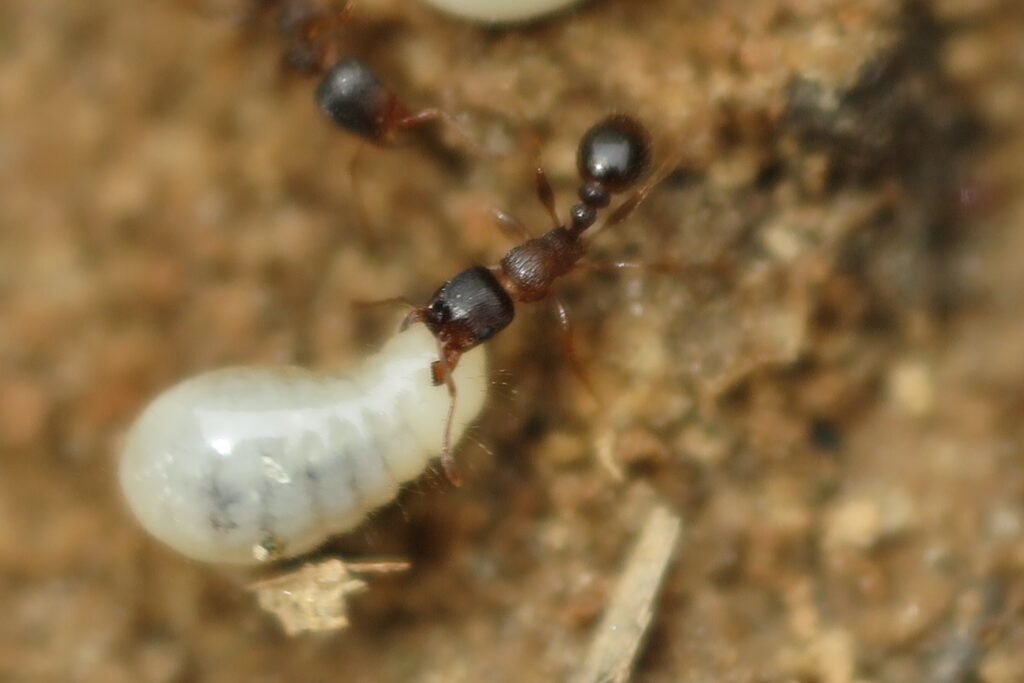
Each piece of brood is handled with precision, gripped firmly in the ant’s mandibles. Even during fast movement, the ants maintain control, ensuring that the brood is not dropped or damaged. This careful handling highlights the importance of these stages within the colony.
General Characteristics of Red Ant (Myrmica Ant) Colonies and Brood Transport
Myrmica ants are small, reddish-brown insects with a segmented body structure that includes a distinct two-part waist. Their size, typically between 4 and 7 millimeters, makes them comparable to a sesame seed, yet their coordinated activity gives them a much larger presence. When viewed up close, their bodies appear slightly glossy, with subtle variations in color across different segments.
One of the most recognizable features of these ants is their proportionally large head and flexible antennae, which are constantly in motion. These antennae allow them to interact with their surroundings and other ants, contributing to their coordinated activity. Their legs are relatively long, giving them a quick and agile movement style.
Compared to other common ants, such as pavement ants, Myrmica ants often appear more slender and slightly lighter in coloration. Pavement ants tend to be darker and more compact, while Myrmica ants have a more elongated form. This difference becomes noticeable when observing them in similar environments.
During brood transport, these physical traits become more apparent. Their small size allows them to move quickly through tight spaces, while their structure supports the ability to carry objects larger than themselves. This combination of form and function enables them to relocate brood efficiently when needed.
Role of Ant Relocation in the Ecosystem and Colony Survival
The movement of brood during relocation is a critical part of how ant colonies maintain stability within their environment. These developing individuals represent the future of the colony, and their protection is essential for long-term survival. By relocating them quickly, ants ensure that growth continues even after disturbance.
In a broader ecological context, ant colonies contribute to the structure and health of their environment. Their underground systems influence soil composition, while their activity helps redistribute organic material. The continued development of new ants supports these processes over time.
Relocation events also highlight the connection between ants and other organisms. When brood is exposed, it can become vulnerable to predators, linking ants to the wider food web. This interaction demonstrates how even brief moments of activity can have ecological significance.
Overall, the act of moving what appear to be “eggs” is part of a much larger system of survival and renewal. It reflects the efficiency and organization of ant colonies, as well as their role in maintaining balance within their ecosystems. Observing this behavior offers a deeper understanding of how these small insects contribute to the natural world.