
White-Tailed Deer Scapula Surface Features & Landmarks Guide
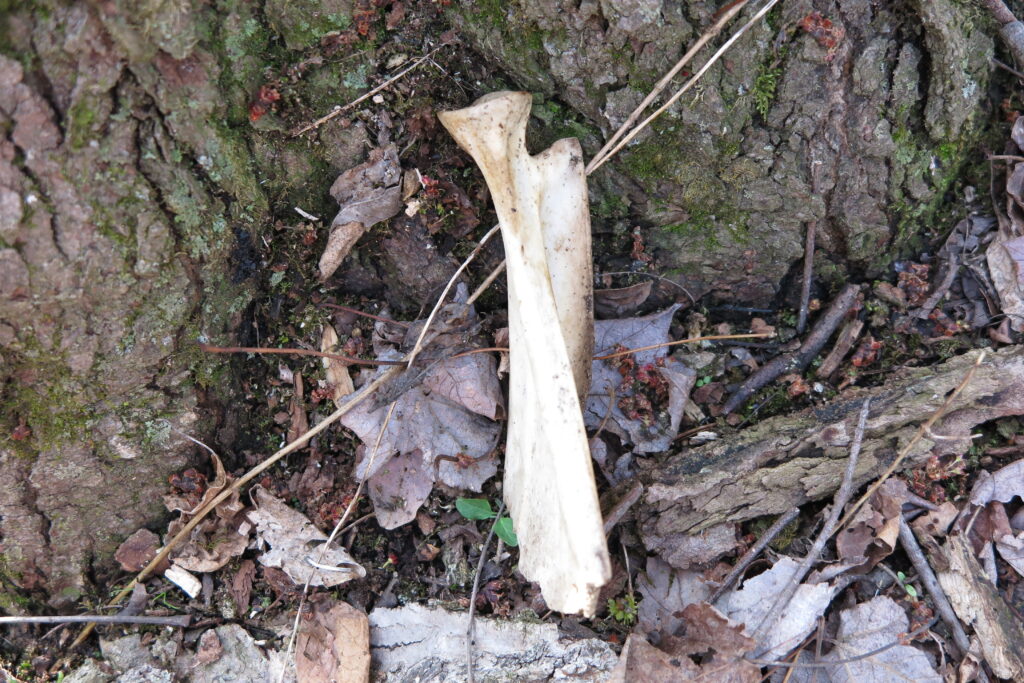
Quick Facts
Bone Composition: Dense outer bone with internal spongy sections
Surface Texture: Smooth, Weathered
Bone Thickness: Thin to Moderate
Curvature: Slightly Curved and Flared
Edges & Break Pattern: Broken lower blade edge with weathered fracture surfaces
Visible Landmarks: Glenoid cavity, scapular neck, blade margins, attachment ridges
Weight: Lightweight
Symmetry: Asymmetrical
Structural Strength: Moderate with reinforced joint region
White-Tailed Deer Scapula Surface Features and Identification Landmarks
The white-tailed deer scapula is a broad shoulder bone that forms part of the front limb assembly. Commonly referred to as the shoulder blade, it is one of the larger flat bones found within the deer skeleton. Even when fragmented, portions of the scapula often remain recognizable because of their distinctive shape and preserved joint surfaces.
White-tailed deer inhabit a vast range stretching across much of North America and into portions of Central and South America. Their ability to thrive in forests, farmland, wetlands, and suburban environments means skeletal remains may be encountered in many different landscapes. As a result, deer bones are among the most frequently discovered large mammal remains in the region.
Unlike long bones such as the femur or humerus, the scapula presents a broad, flattened appearance. This unique profile often catches the attention of hikers, hunters, and wildlife enthusiasts who encounter skeletal remains during outdoor exploration. Even weathered fragments can retain enough of their original outline to suggest their identity.
The specimen examined here represents a partial scapula rather than a complete shoulder blade. Although sections of the lower blade are missing, the surviving features remain clear enough for identification. This preserved structure provides an excellent example of how recognizable landmarks can remain visible long after a bone has broken.
White-Tailed Deer Scapula Overall Form and Surface Appearance
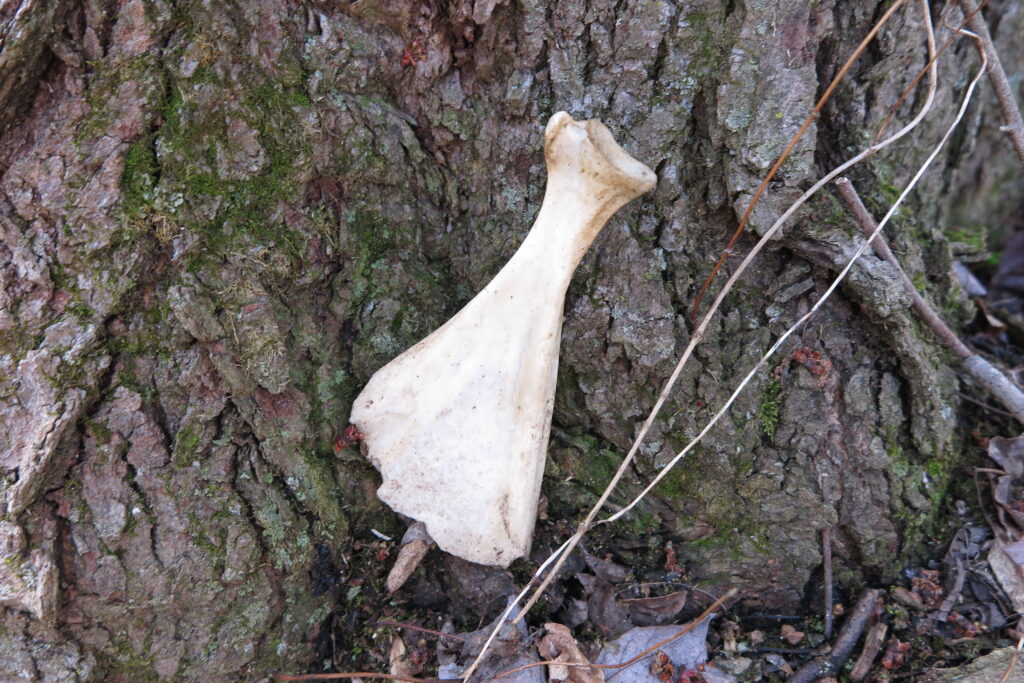
At first glance, a white-tailed deer scapula fragment appears as a flattened section of bone that widens noticeably toward one end. The preserved portion displays a broad blade-like profile that gradually narrows into a more compact neck region. This changing width creates a shape unlike the cylindrical shafts commonly associated with leg bones.
The overall appearance resembles a weathered paddle blade or a thin triangular plate. Rather than maintaining a consistent thickness throughout, the bone expands and contracts across different regions. These gradual transitions contribute to its distinctive visual profile when viewed from multiple angles.
Surface coloration often varies depending on exposure time and environmental conditions. This specimen displays the pale cream and light tan tones frequently seen on weathered bones. Minor staining and discoloration occur naturally as moisture, sunlight, and organic debris interact with the bone over time.
The fragment retains smooth surfaces across much of its preserved area. While weathering has softened some details, the overall shape remains remarkably clear. This combination of broad surfaces and narrowing contours helps separate the scapula from many other skeletal elements encountered in the field.
Viewed from the side, subtle curves become apparent across the blade region. The bone is not perfectly flat but instead follows a gentle contour that gives it depth and dimensionality. These curves become easier to appreciate when the specimen is rotated and examined from different perspectives.
Compared to a rib, the scapula possesses far greater width and surface area. Compared to a pelvis, however, it appears thinner and lacks the large openings typically associated with hip bones. Such visual comparisons can help observers narrow down identification before examining specific landmarks.
Even in fragmentary condition, the remaining blade preserves enough of the original shape to suggest a shoulder bone. The gradual flare outward from the neck region remains visible despite the loss of portions of the lower margin. This surviving geometry serves as one of the most recognizable aspects of the specimen.
Because the scapula combines broad surfaces, smooth contours, and a lightweight appearance, it often stands out among surrounding natural materials. These qualities make it one of the more visually distinctive deer bones encountered during skeletal identification.
White-Tailed Deer Scapula Construction and Bone Structure
The scapula is classified as a flat bone, meaning its overall structure differs significantly from the hollow tubular design seen in many limb bones. The exterior consists primarily of dense compact bone that provides strength while maintaining a relatively lightweight form. Beneath this outer layer lies internal spongy bone that helps distribute forces throughout the structure.
This specimen demonstrates the thin construction characteristic of deer scapulae. Across much of the preserved blade, the bone remains surprisingly slender despite its overall size. The thin profile reduces weight while still maintaining enough rigidity to preserve its shape.
Thickness varies throughout the fragment. Areas approaching the neck and joint region become noticeably more robust than the broad blade surfaces. This uneven construction reflects the natural reinforcement present in regions subjected to greater mechanical stress during life.
The bone displays a gentle curvature rather than forming a perfectly flat sheet. This subtle contour strengthens the structure in much the same way a curved metal panel gains rigidity compared to a flat piece of material. The result is a lightweight yet durable skeletal component.
Weathered fracture surfaces reveal differences between the dense outer layer and the more porous internal structure. In broken areas, the spongy interior can sometimes become visible, displaying a network of tiny interconnected spaces. These internal sections help reduce overall mass while maintaining structural integrity.
Compared to a deer rib, the scapula possesses considerably greater surface area and a broader profile. Compared to the skull, however, it lacks the complex network of sutures and fused plates that characterize cranial bones. These distinctions highlight the unique construction of the shoulder blade.
The preserved fragment remains relatively lightweight despite its dimensions. A person handling the specimen often expects it to weigh more based on its size alone. This balance between size and mass is a defining characteristic of many flat bones.
Overall, the scapula’s construction combines compact bone, internal spongy tissue, moderate thickness variation, and gentle curvature into a highly efficient design. Even as a fragment, these structural characteristics remain visible and contribute to the bone’s recognizable appearance.
White-Tailed Deer Scapula Identification Features and Surface Landmarks
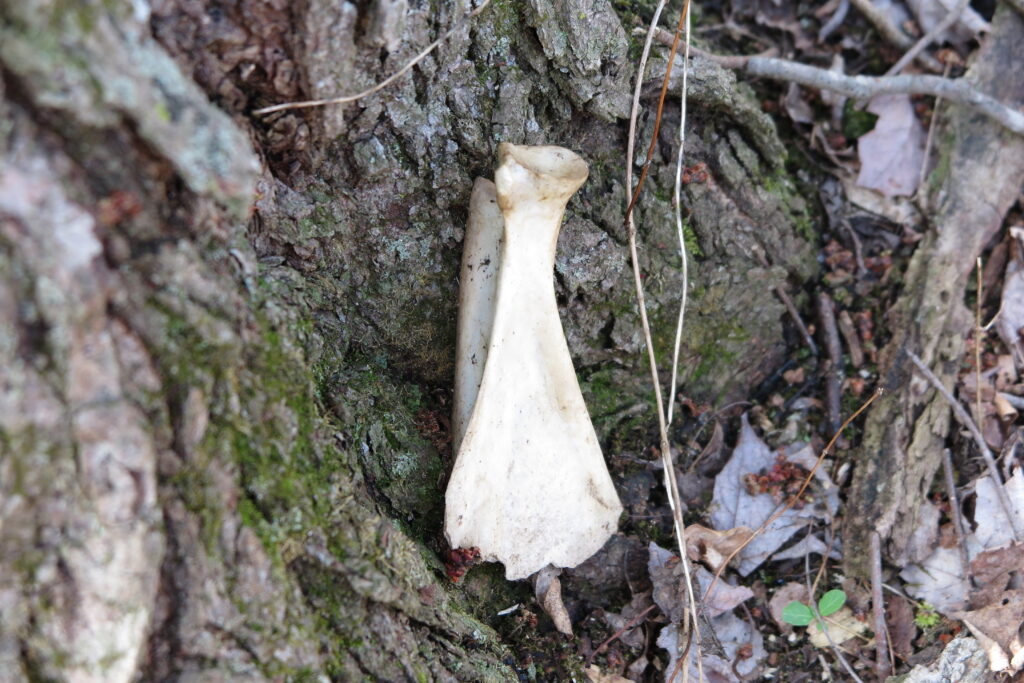
Several visible landmarks help distinguish a deer scapula from other skeletal elements. The most important feature preserved on this specimen is the shoulder joint region, known as the glenoid cavity. This smooth, rounded surface immediately suggests an articulation point where another bone was once attached.
Adjacent to the joint area lies the scapular neck, a narrowed section connecting the broader blade to the shoulder socket. This constricted region creates a recognizable transition between two distinct portions of the bone. The narrowing effect is often one of the first identification clues noticed by experienced bone collectors.
The blade margins provide additional evidence of identification. Even though portions of the lower scapula are missing, the surviving edges reveal the original widening pattern of the shoulder blade. This gradual flare differs significantly from the straighter profiles seen in many other bones.
Subtle ridges and raised attachment surfaces remain visible across portions of the fragment. Although weathering has softened some details, these features create texture variation across the otherwise smooth bone surface. Such ridges frequently help distinguish a scapula from similarly sized flat bone fragments.
One useful field comparison involves distinguishing a scapula from a pelvis fragment. A pelvis typically contains large openings and more complex curves, while the scapula presents a cleaner blade-like form with a distinct shoulder socket. The preserved joint surface on this specimen strongly favors scapula identification.
Another common confusion occurs with large skull fragments. However, skull bones generally display sutures, irregular openings, and more complex contours. The broad uninterrupted surfaces seen on this specimen are more consistent with a shoulder blade than cranial material.
The weathered break along the lower portion reveals where part of the blade has been lost. Despite this damage, the surviving landmarks remain concentrated near the upper region, preserving the most useful identification features. This explains why the specimen remains relatively easy to recognize despite being incomplete.
Taken together, the glenoid cavity, narrowed neck, blade expansion, preserved margins, and subtle attachment ridges create a combination of features rarely duplicated by other deer bones. These landmarks allow confident identification even when only a portion of the original scapula remains intact.
Popular Searches About Deer Scapula
Explore Deer Scapula Guide
Explore More Bones

Support Encounters World
Help support wildlife photography and get behind the scenes discoveries on Patreon.