Eastern Skunk Cabbage Overview: Identification, Characteristics, Appearance, and Key Facts
Quick Facts
Scientific Name: Symplocarpus foetidus
Common Name: Eastern Skunk Cabbage
Plant Type: Perennial
Average Height: 1–3 feet (30–90 cm)
Spread Width: 2–4 feet (60–120 cm)
Leaf Type: Broadleaf
Growth Form: Clumping
Bloom Color: Maroon, Purple, Yellow, and Green
Native Range: Eastern North America
Toxicity: Toxic to humans & pets
Location Observed: Pennsylvania, USA
Field Observation
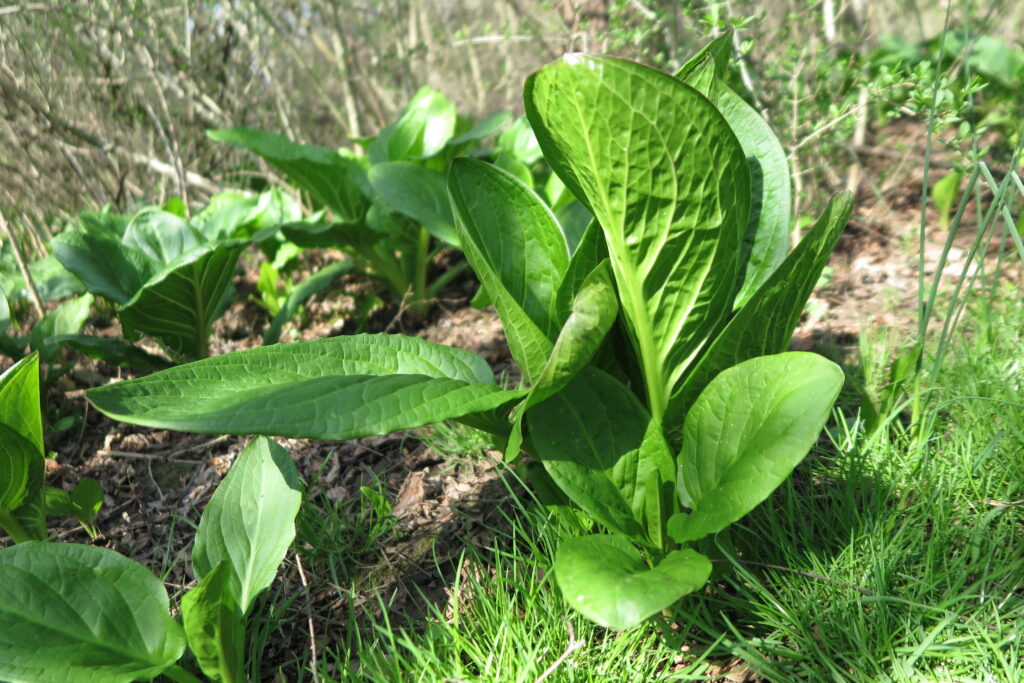
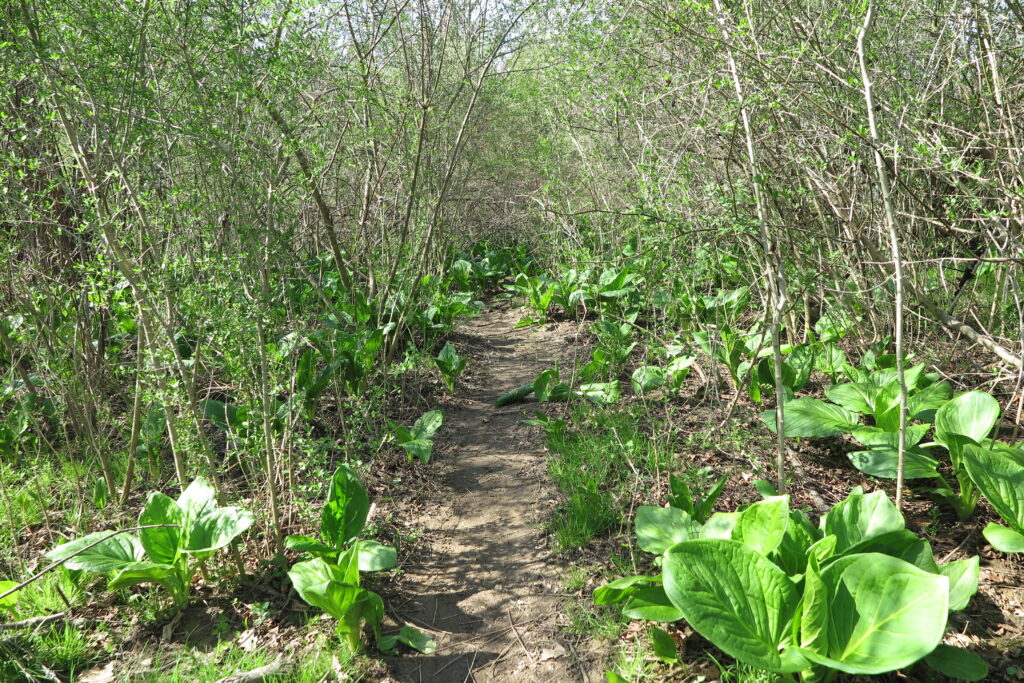
I observed a large colony of Eastern Skunk Cabbage spread across the forest floor, growing throughout both wetlands and damp woodland areas. Many plants formed dense clusters with thick stems supporting massive green leaves, creating one of the most prominent patches of vegetation visible along the trail.
Eastern Skunk Cabbage in the Wild: An Introduction to a Remarkable Native Plant
A walk through a quiet wetland in early spring often reveals one of North America’s most unusual native plants long before most wildflowers appear. Eastern Skunk Cabbage (Symplocarpus foetidus) has earned a reputation as a botanical curiosity because it emerges during a season when many other plants remain dormant. Its presence signals the transition between winter and spring in forests, swamps, and floodplain landscapes across much of eastern North America.
This species belongs to the arum family, a group known for producing distinctive flowers and bold foliage. Eastern Skunk Cabbage stands apart even within that family due to its unusual appearance and unmistakable odor. Naturalists frequently encounter it while exploring damp woodland trails, where its broad leaves can become one of the most prominent plants on the landscape.
Its native range extends throughout much of eastern Canada and the eastern United States. Generations of hikers, botanists, and wildlife enthusiasts have become familiar with the plant’s striking presence in spring. Because it is native rather than introduced, it forms a long-established part of many natural ecosystems across its range.
Eastern Skunk Cabbage attracts attention from people who may not normally notice plants. The sheer size of its leaves, combined with its unusual appearance, often prompts questions from visitors encountering it for the first time. Even without flowers present, mature plants are difficult to overlook once they reach full size.
Eastern Skunk Cabbage Overall Appearance and Growth Form
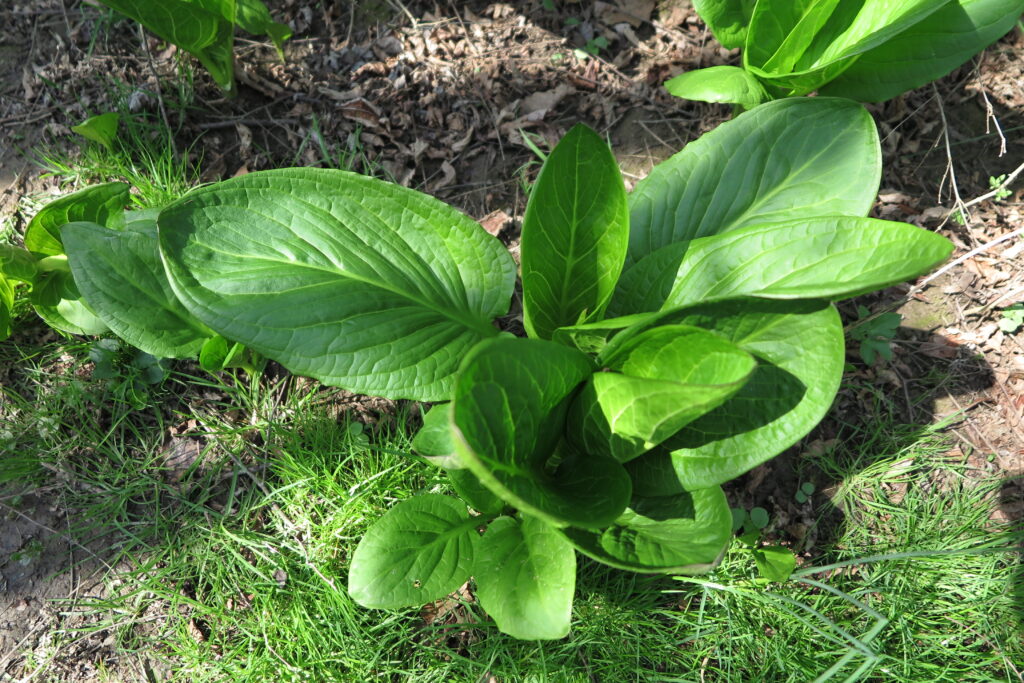
Eastern Skunk Cabbage develops as a robust clump-forming perennial that creates a bold visual statement wherever it grows. Mature plants produce large masses of foliage that emerge directly from the ground rather than from a woody stem. This growth habit gives the plant a compact yet impressive appearance despite lacking an upright trunk or branching structure.
From a distance, established plants often resemble oversized clusters of tropical foliage. Individual leaves rise from a central crown and spread outward in multiple directions, creating a fountain-like shape. A mature clump can occupy several feet of space and quickly become one of the most visually dominant plants in the surrounding area.
The plant’s overall form remains consistent across much of its range. Whether growing in northern portions of its distribution or farther south, Eastern Skunk Cabbage generally maintains the same broad, leafy profile. Environmental conditions may influence size, but the recognizable shape remains remarkably similar.
Large colonies create a particularly impressive display. When multiple plants occur together, their leaves can form sweeping patches of bright green vegetation across the landscape. These groupings often create a dramatic contrast with surrounding shrubs, grasses, and woodland plants.
Despite its substantial appearance, Eastern Skunk Cabbage retains a simple overall structure. It lacks the complex branching patterns seen in shrubs and trees, instead relying on its massive leaves to create visual impact. This straightforward growth form contributes greatly to its distinctive character and makes it easy to recognize from a considerable distance.
Distinctive Eastern Skunk Cabbage Characteristics
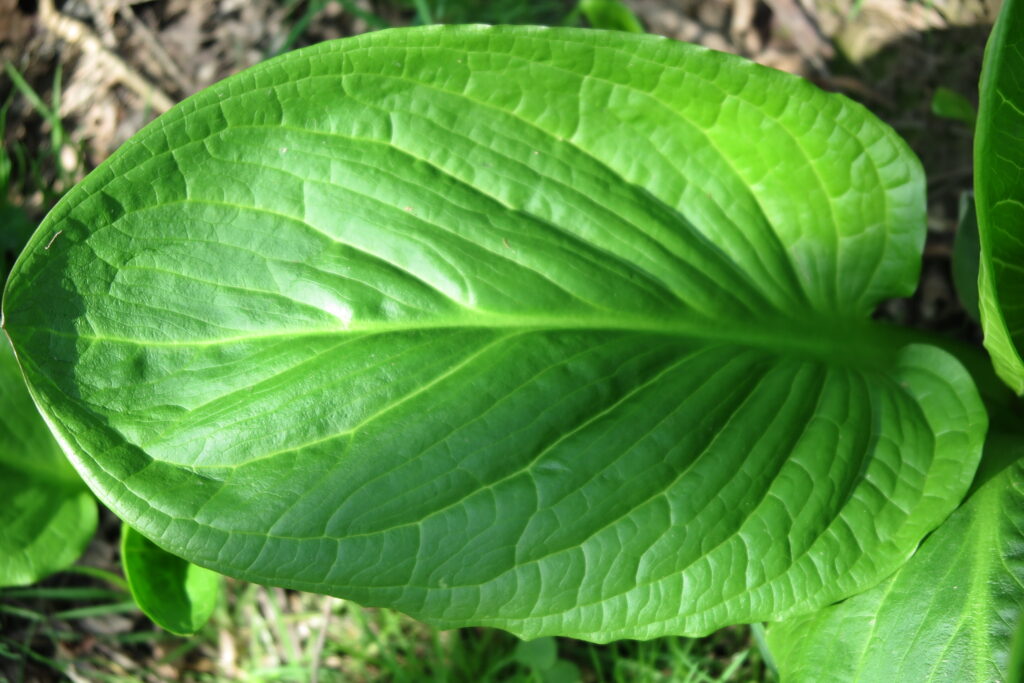
The leaves are unquestionably the plant’s most defining feature. Mature foliage is broad, smooth, and strongly veined, often reaching lengths that exceed a foot. Their size alone separates Eastern Skunk Cabbage from many neighboring wetland plants and creates an unmistakable presence in the landscape.
Leaf coloration is typically a rich, vibrant green that remains attractive throughout the active growing season. Fresh growth often appears especially bright, creating a lush appearance that stands out against darker woodland vegetation. The smooth surfaces reflect sunlight gently without producing the glossy shine seen in some other broadleaf species.
The texture of the leaves is another identifying characteristic. They feel thick, somewhat fleshy, and substantial when handled. A useful comparison is the texture of sturdy garden hosta leaves, although Eastern Skunk Cabbage typically develops much larger foliage and stronger veining.
Prominent veins radiate through each leaf, creating a structured pattern that remains visible even from several feet away. These veins help support the large leaf surface and contribute to the plant’s bold appearance. Their arrangement gives the foliage a slightly sculpted look rather than a flat, featureless surface.
Perhaps the most famous characteristic is the odor that inspired the plant’s common name. When damaged, crushed, or disturbed, plant tissues release a scent often compared to that of a skunk. While not always noticeable from a distance, this distinctive smell serves as an additional identifying feature and has become one of the species’ most well-known traits.
How to Identify Eastern Skunk Cabbage in the Field
Field identification usually begins with the leaves. Few native plants in eastern North America produce such large, broad foliage emerging directly from ground level. A mature clump can be recognized from considerable distance because the leaves create a dense, almost architectural form that stands apart from surrounding vegetation.
Each leaf is oval to broadly elliptical and narrows toward the base where it connects to the crown. The strong central vein and numerous secondary veins create a textured appearance across the leaf surface. These features remain visible even when the plant is viewed from several yards away.
One common identification mistake involves confusing Eastern Skunk Cabbage with False Hellebore (Veratrum viride). Both species can develop large leaves and occur in moist environments. However, False Hellebore produces leaves arranged around a central stem, while Eastern Skunk Cabbage forms a basal clump with leaves arising directly from the ground.
Another helpful comparison involves garden hostas. At first glance, Eastern Skunk Cabbage may resemble an oversized hosta growing in a natural setting. Closer examination reveals thicker foliage, stronger veining, and a more substantial overall presence than most ornamental hosta varieties.
When attempting identification, observers should consider the combination of traits rather than relying on a single feature. Massive green leaves, prominent veins, clump-forming growth, and the potential for a skunk-like odor create a unique set of characteristics. Together, these visual markers make Eastern Skunk Cabbage one of the easiest native wetland plants to identify once its appearance becomes familiar.
Observation Location
Observed in Nixon Park Nature Center, Pennsylvania, USA
Popular Searches About Skunk Cabbage
Explore Skunk Cabbage Guide
Explore More Plants

Support Encounters World
Help support wildlife photography and get behind the scenes discoveries on Patreon.