Eastern Skunk Cabbage vs False Hellebore: Key Differences, Identification, and Comparison Guide
Quick Facts
Eastern Skunk Cabbage Scientific Name: Symplocarpus foetidus
False Hellebore Scientific Name: Veratrum viride
Plant Family: Arum Family vs Melanthiaceae Family
Leaf Arrangement: Basal Cluster vs Stem-Wrapping Leaves
Flower Appearance: Hooded Spathe vs Tall Flower Spike
Toxicity: Both Toxic to Humans and Animals
Most Common Misidentification: Young False Hellebore Mistaken for Eastern Skunk Cabbage
Eastern Skunk Cabbage and False Hellebore Overview
Eastern Skunk Cabbage (Symplocarpus foetidus) and False Hellebore (Veratrum viride) are two large-leaved native plants frequently encountered in moist environments across eastern North America. During spring, both species can appear strikingly similar at first glance, particularly when viewed from a distance. Their broad green foliage often leads hikers and beginner naturalists to confuse one for the other.
The confusion becomes understandable when both plants are emerging and developing fresh leaves. Large green foliage dominates the visual appearance of each species, creating an impression of similarity before closer inspection reveals important differences. Learning these distinctions can make field identification much easier.
Although they share certain environmental preferences, the two plants belong to entirely different botanical families. Eastern Skunk Cabbage is a member of the arum family, while False Hellebore belongs to the bunchflower family. Their evolutionary histories, flower structures, and growth habits differ considerably despite superficial similarities.
Correct identification is especially important because both plants are toxic and play unique ecological roles within native ecosystems. Fortunately, several visual clues make distinguishing them relatively straightforward once you know what characteristics to examine.
Comparing Overall Appearance and Growth Form
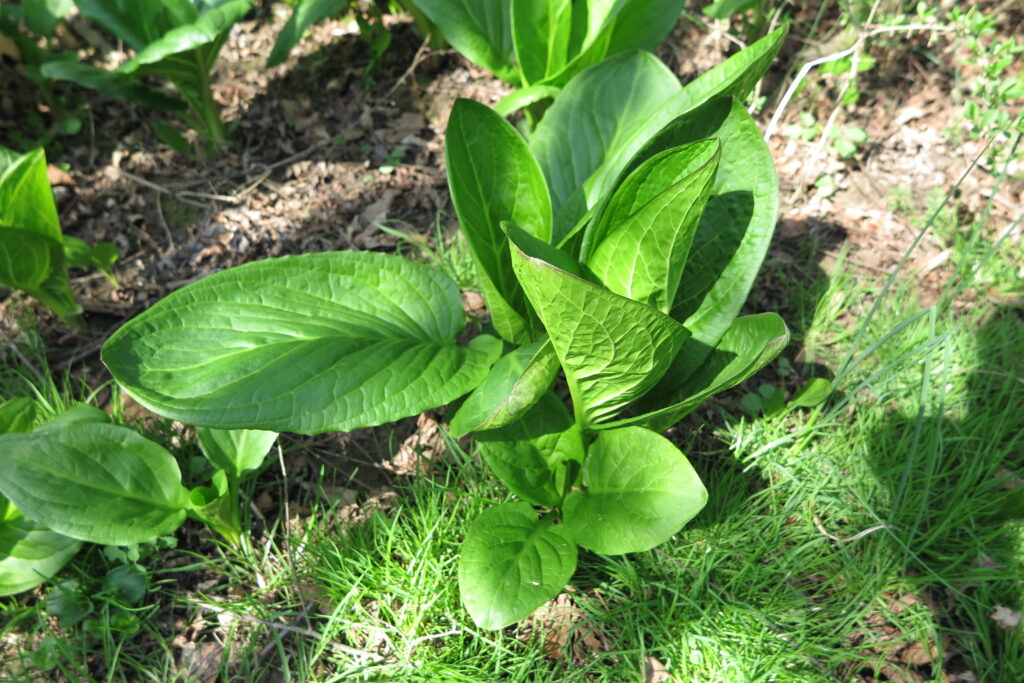
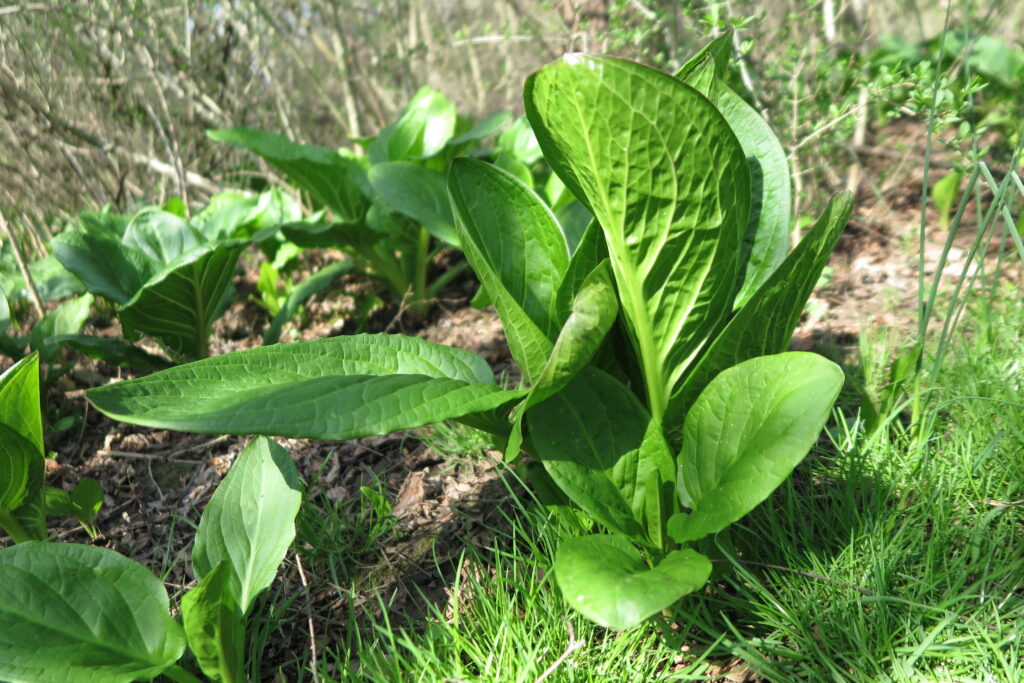
Eastern Skunk Cabbage develops as a dense basal clump with leaves emerging directly from the ground. The foliage radiates outward from a central crown, creating a fountain-like appearance that spreads broadly across the forest floor. Mature plants often resemble oversized hostas growing in natural settings.
False Hellebore follows a very different architectural design. Instead of producing a low central clump, it develops an upright stem that supports leaves along its length. This structure gives the plant a much taller and more vertical appearance than Eastern Skunk Cabbage.
From a distance, Eastern Skunk Cabbage often appears wider than it is tall. The leaves arch outward and create a rounded profile that occupies significant horizontal space. False Hellebore typically creates the opposite effect, drawing the eye upward with its towering stem and layered foliage.
A useful comparison is the difference between a fountain and a pillar. Eastern Skunk Cabbage spreads outward like water flowing from a fountain basin, while False Hellebore rises upward like a green column. This overall growth form is often the quickest way to separate the two species in the field.
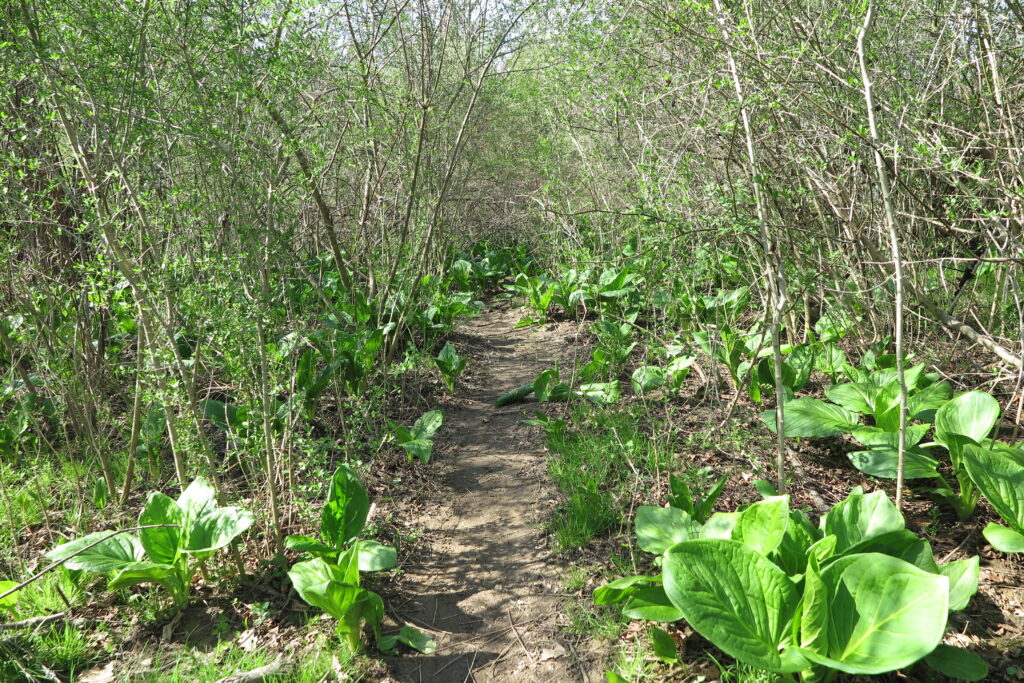
The contrast becomes even more obvious as plants mature. Large Skunk Cabbage colonies form broad patches of arching leaves, whereas False Hellebore stands prominently above surrounding vegetation. Observing the entire plant before focusing on individual details often leads to a correct identification.
Leaf, Stem, and Structural Differences
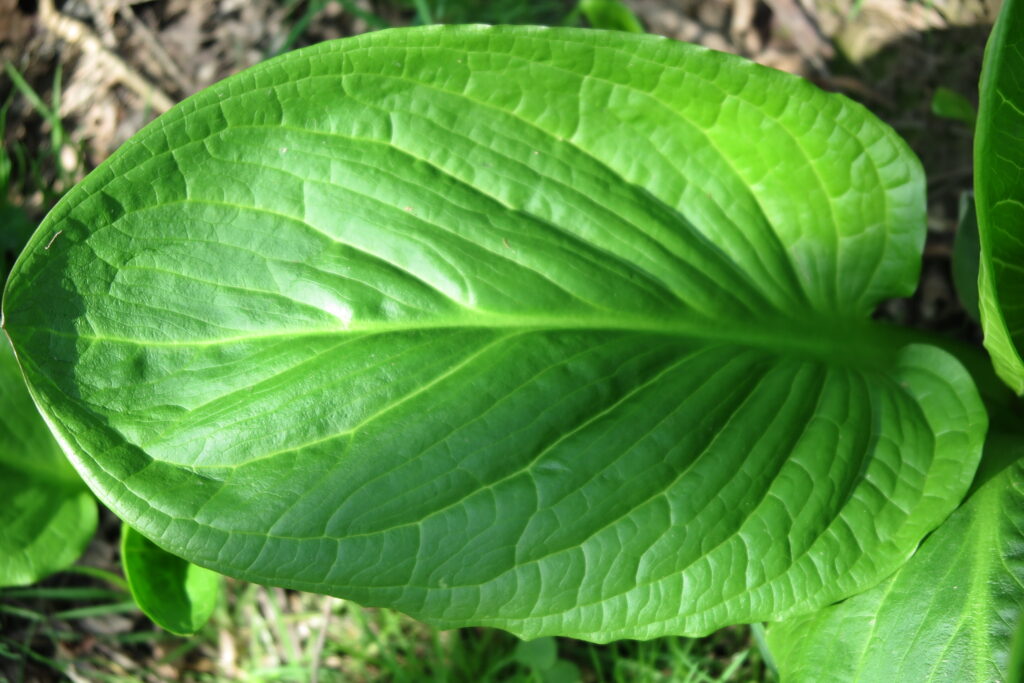
The leaves of Eastern Skunk Cabbage are smooth, oval to elliptical, and attached individually to thick basal stalks. Each leaf emerges separately from the plant’s central crown. Strong veins create a textured appearance, but the leaf surface itself remains relatively smooth.
False Hellebore leaves possess a distinctly different arrangement. Rather than emerging individually from ground level, they wrap around a central stem in a layered pattern. This arrangement creates a spiral or stacked appearance that immediately distinguishes the species from Eastern Skunk Cabbage.
Leaf texture also provides an important clue. False Hellebore foliage often appears heavily pleated, with pronounced parallel veins creating a ribbed surface. Eastern Skunk Cabbage leaves are generally smoother and broader, lacking the deeply corrugated appearance characteristic of False Hellebore.
A helpful comparison is folded fabric versus smooth leather. False Hellebore leaves resemble material that has been carefully pleated, while Eastern Skunk Cabbage foliage appears more uniform and gently curved. This textural difference remains visible even from several feet away.
The stem is perhaps the most decisive feature. Eastern Skunk Cabbage lacks a tall central stem entirely, while False Hellebore depends on one for support. If a plant displays large leaves attached directly to a prominent upright stalk, it is almost certainly False Hellebore rather than Eastern Skunk Cabbage.
Flower Differences and Common Identification Mistakes
The flowers of these plants are completely different and eliminate most identification uncertainty when present. Eastern Skunk Cabbage produces a hooded structure called a spathe that surrounds a rounded spadix. These flowers emerge near ground level and often appear before the leaves become fully developed.
False Hellebore develops tall flowering spikes that rise above the foliage. Hundreds of small greenish-yellow flowers are arranged along a vertical stem, creating an appearance more similar to a traditional flowering stalk. The structure is dramatically different from the enclosed flower of Eastern Skunk Cabbage.
One of the most common identification mistakes occurs during spring when False Hellebore leaves are still young and unfolded. At this stage, observers may focus only on the broad green foliage and assume they are looking at Eastern Skunk Cabbage. Closer examination of leaf arrangement usually reveals the correct identification.
Another useful clue involves timing. Eastern Skunk Cabbage flowers are often visible very early in the season, sometimes while snow remains nearby. False Hellebore typically produces its tall flower spikes much later. Observing the presence and structure of flowers can therefore provide valuable identification information.
Although the two species share certain similarities, their differences become obvious when viewed carefully. Basal clumps versus upright stems, smooth leaves versus pleated foliage, and hooded flowers versus towering flower spikes all provide reliable identification markers. Once these features become familiar, distinguishing Eastern Skunk Cabbage from False Hellebore becomes one of the easier plant comparisons encountered in eastern North American wetlands and woodlands.
Popular Searches About Skunk Cabbage
Explore Skunk Cabbage Guide
Explore More Plants

Support Encounters World
Help support wildlife photography and get behind the scenes discoveries on Patreon.