
Creeping Charlie vs Wild Violet: How to Tell the Difference Between These Common Lawn Plants
Quick Facts
Comparison Species: Creeping Charlie vs Wild Violet
Scientific Name (Creeping Charlie): Glechoma hederacea
Scientific Name (Wild Violet): Viola sororia
Plant Family: Mint Family vs Violet Family
Most Common Confusion: Similar Broad Leaves and Low-Growing Growth
Growth Form Difference: Creeping Charlie Forms Mats; Wild Violet Forms Clumps
Flower Color: Purple (Both Species)
Identification Difficulty: Moderate
Native Range: Introduced vs Native (North America)
Introduction to Creeping Charlie and Wild Violet Identification
Creeping Charlie and Wild Violet are two of the most commonly confused broadleaf plants found in North American lawns. Both species grow close to the ground, produce purple flowers, and often appear in the same areas. Their similarities cause many homeowners to assume they are looking at a single plant when two entirely different species may actually be present.
Creeping Charlie (Glechoma hederacea) originated in Europe and parts of Asia before becoming established throughout North America. Wild Violet (Viola sororia), by contrast, is native to much of the eastern United States and Canada. Despite their different origins, the two plants frequently share similar landscapes.
At a quick glance, both species can create green patches scattered throughout turfgrass. During spring, the appearance of purple flowers adds another layer of confusion. From a distance, distinguishing between them can be surprisingly difficult.
Fortunately, several reliable characteristics separate these plants. Differences in leaf shape, growth style, flower structure, and overall appearance make accurate identification possible. Learning these distinctions helps homeowners, gardeners, and nature enthusiasts recognize each species with confidence.
Creeping Charlie vs Wild Violet Growth Habits
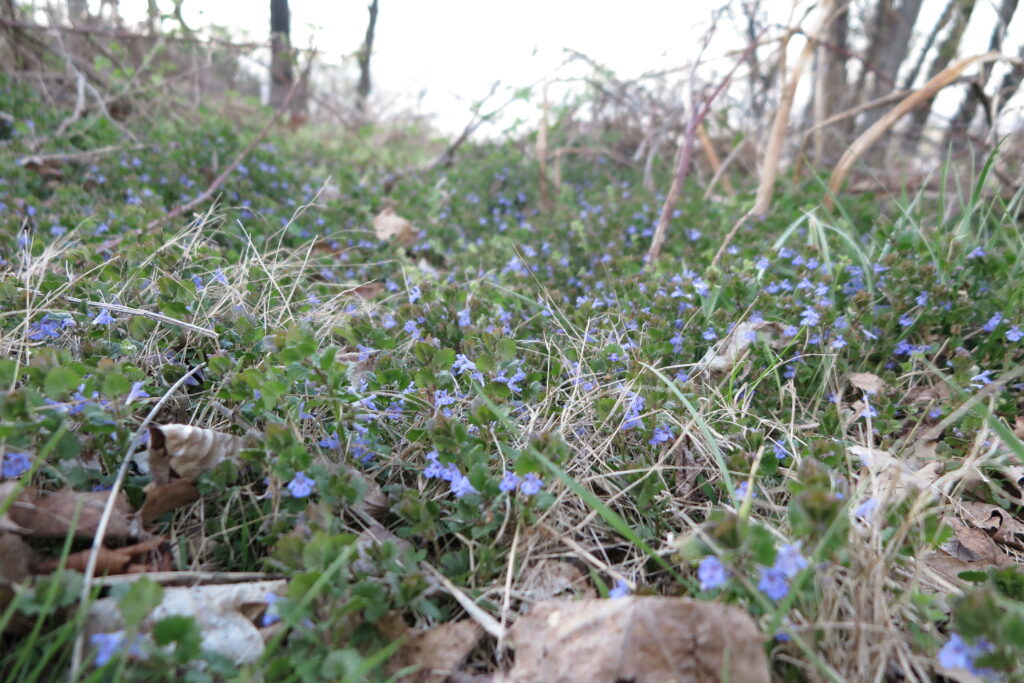
One of the easiest differences to observe involves the way each plant occupies space. Creeping Charlie spreads outward through interconnected stems that creep across the soil surface. Over time, these stems create dense mats that may cover large portions of a lawn or garden.
Wild Violet follows a completely different growth strategy. Instead of spreading as a continuous carpet, it develops from a central crown and produces individual clusters of leaves. These clumps often remain distinct even when multiple plants grow close together.
A useful comparison is to imagine the difference between a blanket and a bouquet. Creeping Charlie resembles a blanket stretched across the ground, while Wild Violet resembles numerous small bouquets emerging from separate points. This contrast is often visible from several feet away.
As Creeping Charlie expands, its stems connect different portions of a colony together. Wild Violet lacks these obvious above-ground runners and instead appears as scattered individual plants or clusters. This difference becomes particularly noticeable when examining larger infestations.
Large lawns frequently contain both species at the same time. In these situations, Creeping Charlie often fills spaces between violet clumps, creating a mixed patchwork of vegetation. Understanding this growth contrast provides one of the quickest routes to accurate identification.

Leaf and Stem Differences Between Creeping Charlie and Wild Violet
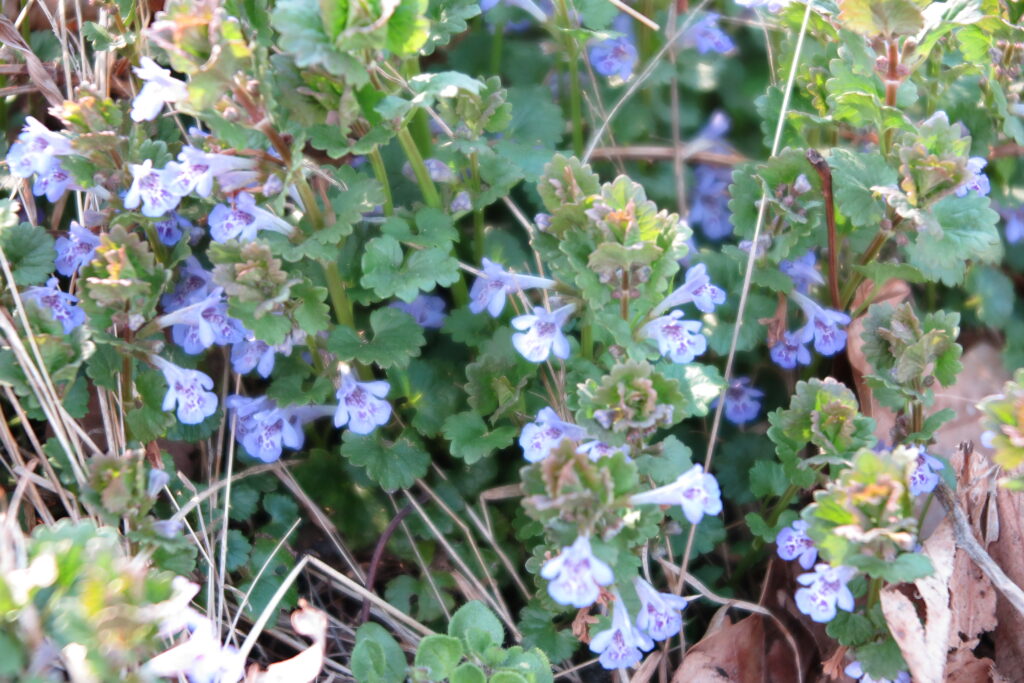
Leaf shape represents one of the most dependable identification tools. Creeping Charlie leaves are rounded to kidney-shaped and feature scalloped or gently toothed margins. The overall appearance is soft and circular, with edges that resemble a decorative border.
Wild Violet leaves possess a distinctly heart-shaped appearance. The leaf base forms a noticeable notch where the stem attaches, creating the classic heart outline many people recognize immediately. This shape differs significantly from the more rounded leaves of Creeping Charlie.
The stems provide another important clue. Creeping Charlie develops square stems that creep along the ground, reflecting its membership in the mint family. Wild Violet lacks square creeping stems and instead produces leaf stalks that rise directly from the plant’s crown.
Leaf arrangement further separates the species. Creeping Charlie leaves grow in opposite pairs along trailing stems. Wild Violet leaves emerge individually from the base, creating a rosette-like cluster rather than a series of paired leaves.
A practical comparison is to imagine miniature lily pads versus small hearts. Creeping Charlie often resembles clusters of tiny lily pads spread across the ground, while Wild Violet appears as collections of green hearts rising from the soil. This visual distinction becomes surprisingly obvious once noticed.
Texture can also assist identification. Creeping Charlie leaves often feel slightly thicker and more textured, whereas Wild Violet leaves generally possess a smoother and softer appearance. Examining several characteristics together usually eliminates any uncertainty.
Flower Identification and Common Misidentification Mistakes
The flowers of these two plants may share a purple coloration, but their structures differ considerably. Creeping Charlie produces small tubular flowers that emerge in clusters from the leaf axils. These blossoms resemble miniature trumpets extending outward from the foliage.
Wild Violet flowers display the classic violet shape familiar to many gardeners. Individual blooms consist of five petals arranged in an open, asymmetrical pattern. Rather than appearing tubular, they spread outward and create a flatter floral display.
Flower placement offers another useful clue. Creeping Charlie flowers remain nestled among the stems and leaves throughout a patch. Wild Violet flowers rise on individual stalks above the foliage, making them appear more isolated and easier to spot.
One of the most common identification mistakes occurs when observers focus only on flower color. Since both plants produce shades of purple, color alone provides little value. Structural differences in the flowers themselves offer far more reliable identification clues.
Another frequent error involves examining only a single leaf. Young Wild Violet leaves may occasionally appear rounded, while some Creeping Charlie leaves can vary slightly in shape. Looking at the entire plant—including flowers, stems, and growth pattern—produces much more accurate results.
For beginners, the simplest rule is to remember that Creeping Charlie creeps while Wild Violet forms clumps. When this observation is combined with heart-shaped violet leaves and tubular Creeping Charlie flowers, distinguishing between the two becomes much easier. These characteristics make it possible to identify even mixed populations growing side by side in the same lawn.
Popular Searches About Creeping Charlie
Explore Creeping Charlie Guide
Explore More Plants

Support Encounters World
Help support wildlife photography and get behind the scenes discoveries on Patreon.