Clown Triggerfish Identification Guide: How to Identify a Clown Triggerfish
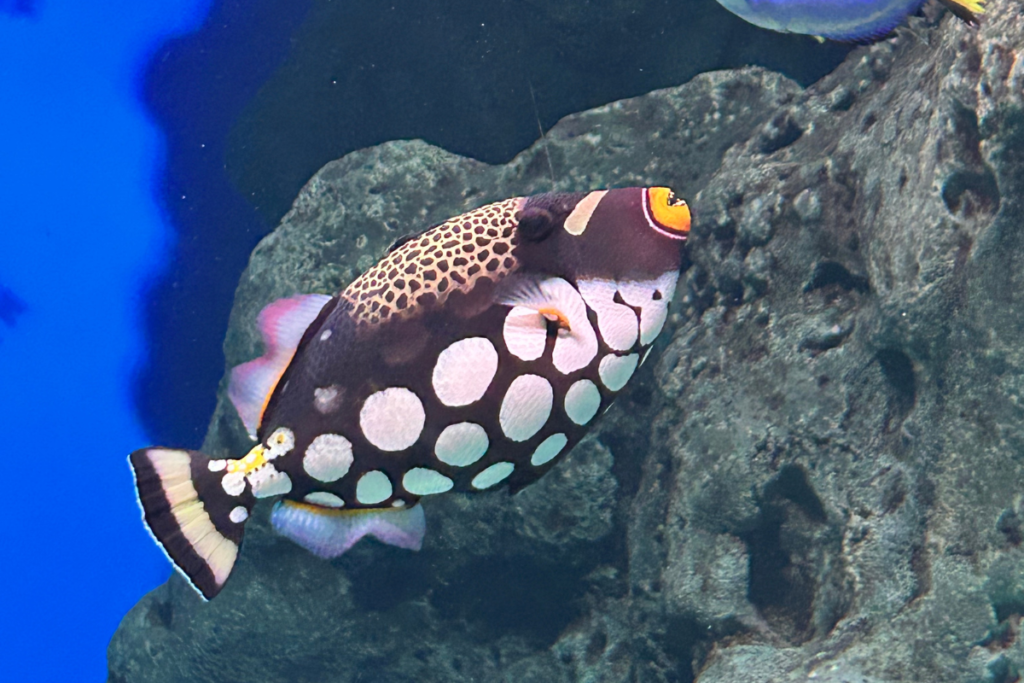
Quick Facts
Identification Difficulty: Easy
Primary Colors: Black, White, Yellow, and Gray
Most Distinctive Feature: Large White Spots on Rear Body
Body Shape: Deep and Compressed Triggerfish Profile
Adult Size: 12–20 Inches (30–50 cm)
Common Confusion Species: Picasso Triggerfish and Queen Triggerfish
Introduction to Clown Triggerfish Identification
The Clown Triggerfish (Balistoides conspicillum) is one of the easiest reef fish to recognize due to its bold coloration and unmistakable body pattern. Found throughout tropical regions of the Indo-Pacific Ocean, this species stands out among the thousands of fish inhabiting coral reef ecosystems. Even individuals with little marine experience can often identify it after a single encounter.
Divers, snorkelers, and aquarium visitors frequently notice the species because its appearance differs dramatically from most neighboring fish. The combination of contrasting colors, large white spots, and bright facial markings creates a visual pattern unlike almost any other reef inhabitant. Few marine species possess such a distinctive design.
Identification becomes even easier when observing adult individuals. Their mature coloration develops into a highly recognizable pattern that remains consistent across much of the species’ range. While minor variations may occur between individuals, the overall appearance rarely causes confusion once key features are understood.
Learning to identify the Clown Triggerfish provides a useful introduction to reef fish recognition. Rather than relying on subtle characteristics visible only to experts, this species displays obvious markings that can often be recognized from considerable distances. Its appearance has made it one of the most photographed and widely recognized triggerfish species in the world.
Clown Triggerfish Appearance and Color Pattern Recognition
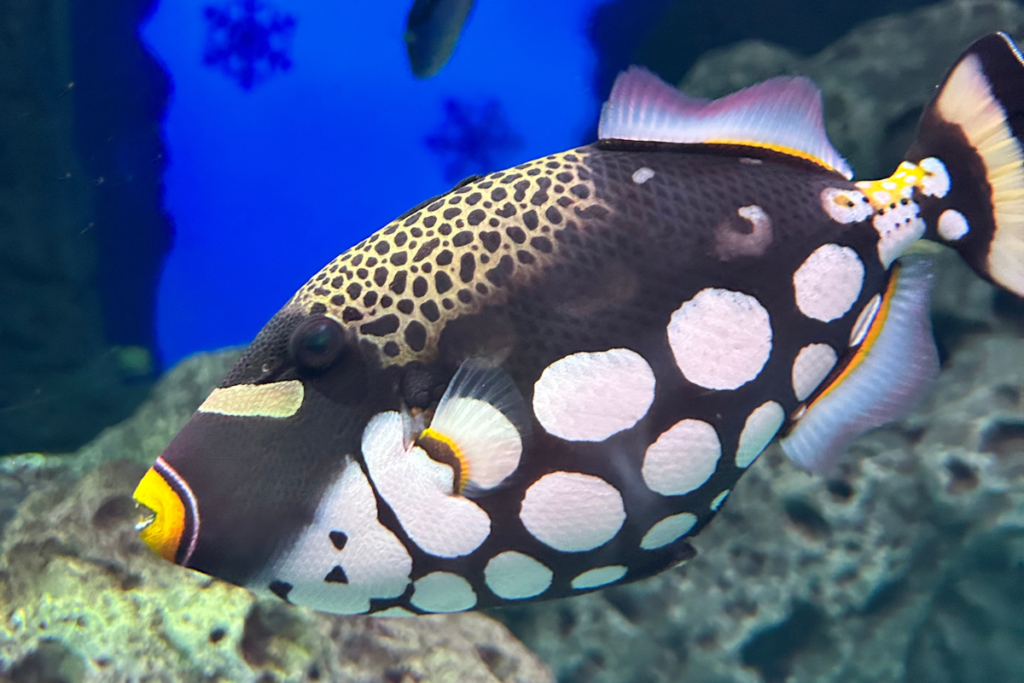
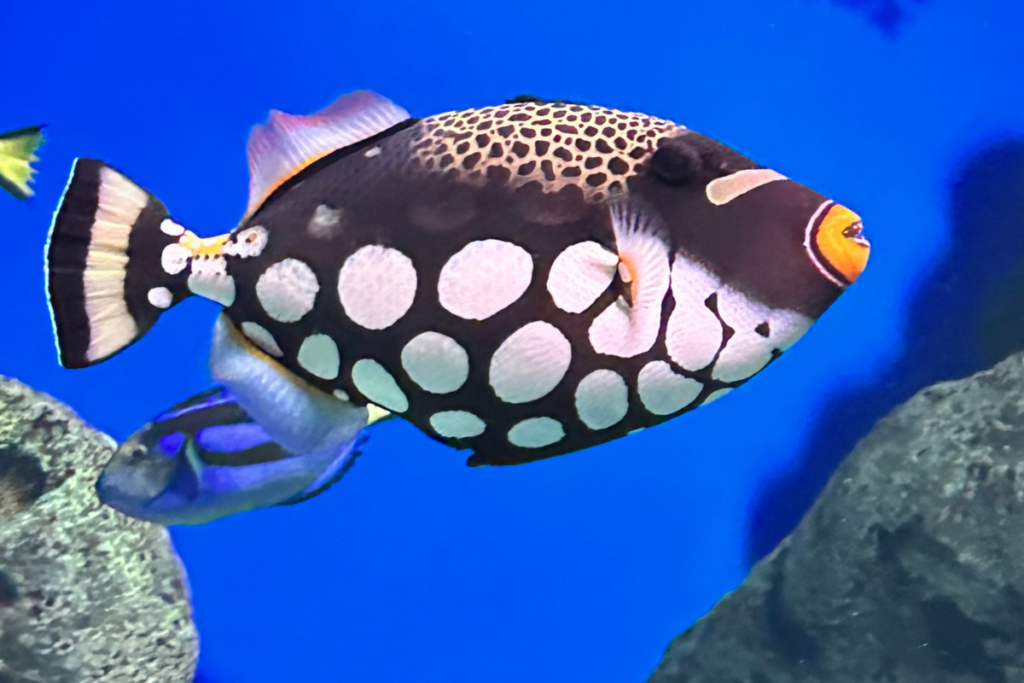
The most striking identification feature is the dramatic contrast between dark body coloration and bright white markings. The rear portion of the body is covered with large, round white spots that immediately draw attention. These spots resemble painted polka dots scattered across a black background.
The upper back displays a completely different pattern. Yellow coloration mixed with irregular black markings creates a design often compared to a leopard’s coat. This intricate section contrasts sharply with the spotted rear body, producing a layered appearance unlike most reef fish.
Facial markings provide another reliable identification clue. A bright yellow mouth stands out against the darker head coloration, while white markings appear around the face and near the eyes. Together, these features create a highly distinctive facial profile that remains recognizable even when only the front of the fish is visible.
Color intensity may vary slightly between individuals depending on age, health, and lighting conditions. However, the overall arrangement of yellow, black, white, and gray remains remarkably consistent. This stability makes coloration one of the most dependable identification tools available.
Viewed from a distance, the fish often appears almost artificial because of its dramatic patterning. Many observers initially compare it to a painted ornament or decorative artwork rather than a naturally occurring animal. This unusual appearance is one reason the species is so memorable.
Clown Triggerfish Body Shape and Physical Characteristics
Beyond coloration, body structure provides additional identification clues. The Clown Triggerfish possesses a deep, laterally compressed body that appears tall relative to its length. This profile creates a sturdy, compact appearance unlike the elongated shapes seen in many reef fish.
Adults typically reach lengths between 12 and 20 inches. A fully grown individual is roughly comparable in length to a large laptop computer or a standard household ruler. Its substantial body depth often makes it appear even larger than its actual length suggests.
The head is broad and powerful, supporting strong jaws and prominent teeth. These features contribute to a robust facial appearance that differs noticeably from the more delicate profiles of many reef species. The mouth remains one of the easiest structural features to recognize.
Another defining characteristic is the trigger spine located on the top of the body. This specialized dorsal spine can be raised and locked into position when needed. While not always visible, its presence is a hallmark feature shared by triggerfish species and helps confirm identification.
The tail also contributes to the species’ distinctive profile. Combined with the rounded body shape and bold coloration, it creates a silhouette that is difficult to confuse with most other reef fish. Even without seeing detailed markings, experienced observers can often recognize the species based on body form alone.
Clown Triggerfish Comparison With Similar Species
The species most commonly confused with the Clown Triggerfish is the Picasso Triggerfish. Both belong to the triggerfish family and share similar body shapes, but their color patterns differ dramatically. Picasso Triggerfish display intricate lines, geometric markings, and angular patterns rather than large white spots.
Queen Triggerfish may also cause occasional confusion among inexperienced observers. However, Queen Triggerfish possess a more streamlined appearance and lack the bold spotted pattern that defines the Clown Triggerfish. Their coloration is generally more subdued and uniform.
Juvenile Clown Triggerfish can present additional identification challenges because their patterns differ from those of adults. Young individuals often display simpler markings and less developed coloration. As growth continues, the familiar white spots and contrasting color scheme become increasingly pronounced.
Compared to most reef fish, the Clown Triggerfish possesses one of the most distinctive appearances in tropical oceans. Identifying it is similar to recognizing a zebra among grazing mammals—once the defining pattern is learned, confusion becomes unlikely. The combination of white spots, yellow facial markings, leopard-like back pattern, deep body shape, and triggerfish profile creates an identification package that is both unique and highly reliable.
For most observers, a single clear view is enough to confirm the species. Few fish combine such dramatic coloration with such a recognizable body form. These characteristics have made the Clown Triggerfish one of the easiest and most rewarding reef fish to identify throughout its Indo-Pacific range.
Popular Searches About Clown Triggerfish
Explore Clown Triggerfish Guide
Explore More Exhibits

Support Encounters World
Help support wildlife photography and get behind the scenes discoveries on Patreon.