Lesser Celandine vs Marsh Marigold: How to Tell the Difference
Quick Facts
Lesser Celandine Scientific Name: Ficaria verna
Marsh Marigold Scientific Name: Caltha palustris
Family: Both Belong to the Buttercup Family (Ranunculaceae)
Flower Color: Yellow in Both Species
Key Difference: Flower Petal Count and Leaf Structure
Native Status: Lesser Celandine Often Invasive; Marsh Marigold Native in Many Regions
Identification Difficulty: Moderate for Beginners
Lesser Celandine and Marsh Marigold Overview
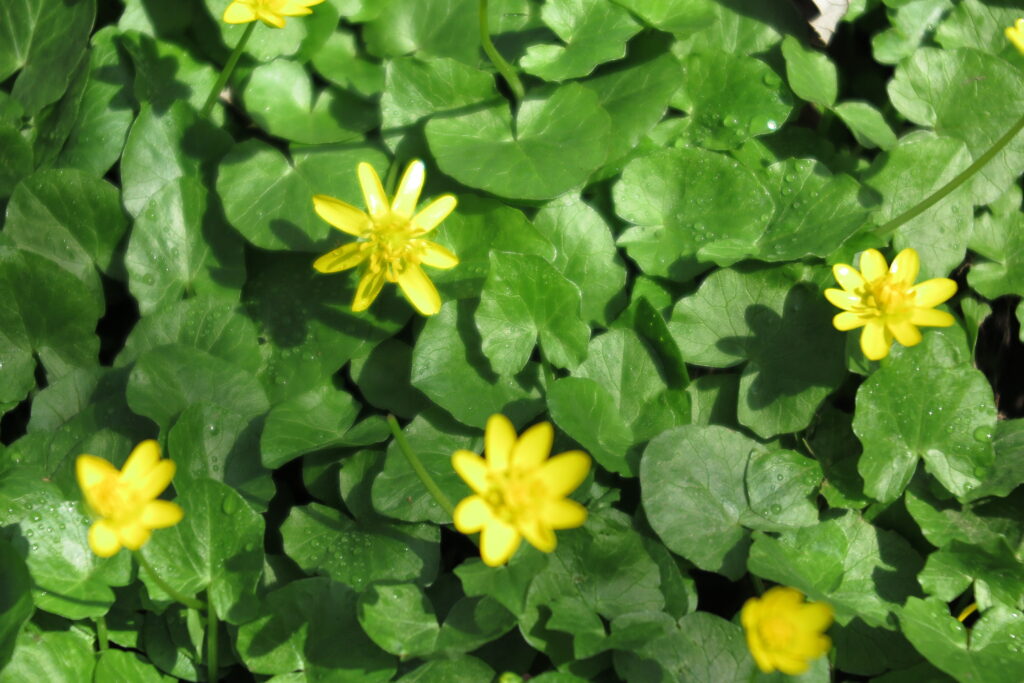
Lesser Celandine (Ficaria verna) and Marsh Marigold (Caltha palustris) are two spring-flowering plants that are frequently confused with one another. Both produce bright yellow flowers, emerge early in the growing season, and belong to the buttercup family. At first glance, especially from a distance, they can appear remarkably similar.
The confusion often begins when observers encounter a patch of yellow flowers along a woodland edge or near a wet area. Without examining the plants closely, many assume they are looking at the same species. This is particularly common during spring when both plants may be flowering at the same time.
Despite their similarities, these species differ significantly in appearance, ecological role, and conservation importance. Marsh Marigold is a native wildflower throughout much of North America and is often considered a desirable component of natural wetlands. Lesser Celandine, by contrast, is widely recognized as an invasive species in many regions outside its native range.
Learning to distinguish these plants is valuable for gardeners, naturalists, photographers, and land managers. Correct identification helps prevent accidental removal of native species while also improving awareness of invasive plant populations. Fortunately, several visible characteristics make separation relatively straightforward once you know what to look for.
Flower Differences Between Lesser Celandine and Marsh Marigold
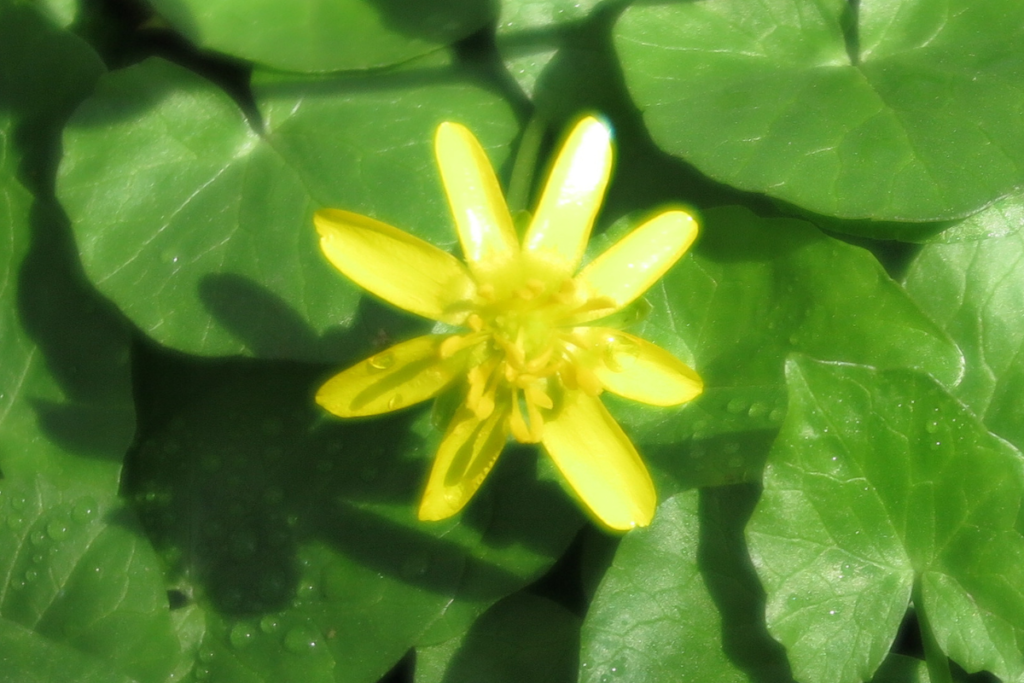
The flowers provide one of the easiest ways to distinguish these species. Lesser Celandine typically produces blooms with numerous narrow petals arranged in a star-like pattern around the center. Most flowers contain between eight and twelve petals, though counts can vary slightly.
Marsh Marigold flowers look noticeably different when viewed up close. Instead of numerous slender petals, they display fewer but much broader petal-like sepals. The result is a flower that appears fuller and rounder compared to the pointed, starburst appearance of Lesser Celandine.
A useful comparison is to imagine two yellow suns. Lesser Celandine resembles a sun with many thin rays extending outward, while Marsh Marigold resembles a simple yellow disk with broader edges. This visual distinction is often noticeable even from several feet away.
Flower size can also help with identification. Marsh Marigold generally produces larger blossoms that stand out individually. Lesser Celandine flowers are usually smaller, though large colonies can create a more dramatic display because of their sheer numbers.
When uncertain, counting petals is often one of the quickest identification methods. Numerous narrow petals strongly suggest Lesser Celandine, while a flower with fewer, broader segments points toward Marsh Marigold. This characteristic alone resolves many identification mistakes.
Comparing Leaves, Stems, and Overall Growth Form
Leaf structure offers another reliable way to separate these two plants. Lesser Celandine produces glossy, heart-shaped to kidney-shaped leaves with a smooth, almost polished appearance. The foliage often reflects sunlight, giving colonies a shiny green look.
Marsh Marigold leaves are generally larger, thicker, and less glossy. They often appear more rounded and substantial, with a texture that feels sturdier than the delicate foliage of Lesser Celandine. Individual leaves can be noticeably larger than those found on neighboring Lesser Celandine plants.
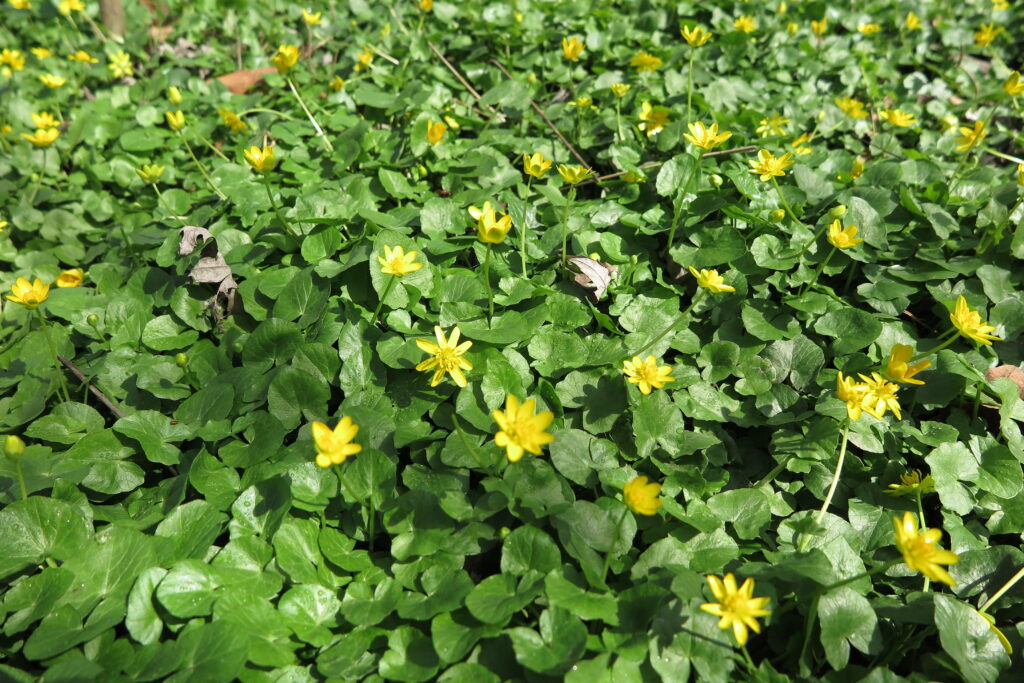
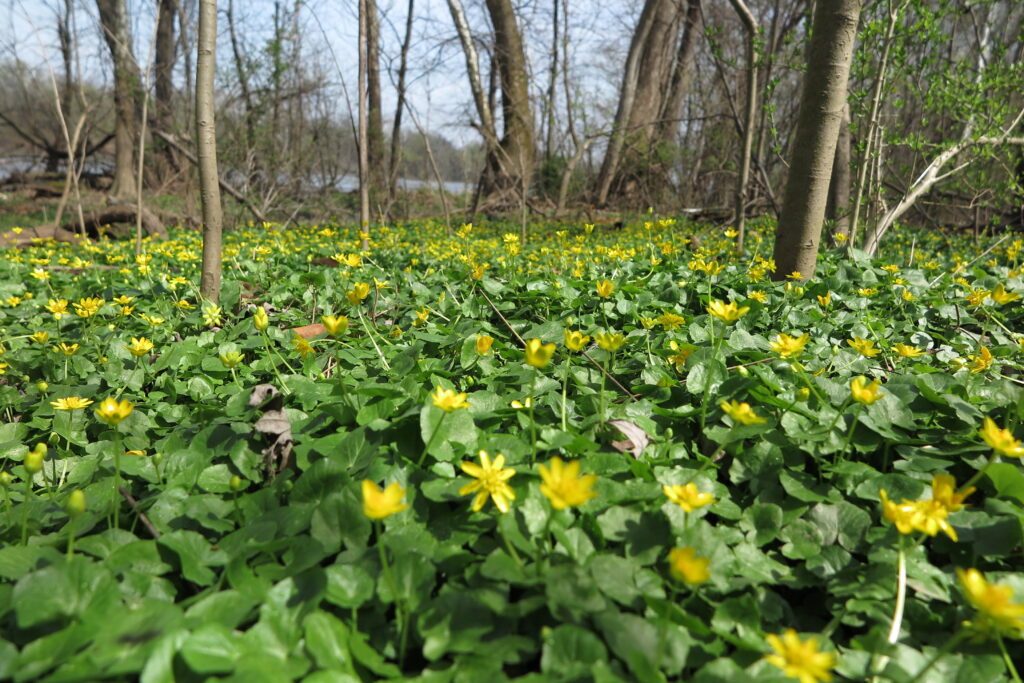
Growth form provides additional clues. Lesser Celandine spreads outward as a low-growing carpet that hugs the ground. Large infestations can resemble a green blanket covered with yellow stars, extending continuously across an area.
Marsh Marigold grows in more defined clumps rather than forming expansive mats. Individual plants remain distinct and upright, producing a fuller appearance. Instead of covering the ground like a rug, Marsh Marigold often resembles a collection of leafy mounds topped with bright flowers.
Stem structure also differs. Lesser Celandine typically maintains short, inconspicuous stems hidden beneath the foliage. Marsh Marigold develops thicker and more noticeable stems that elevate flowers above the surrounding leaves, creating a taller and more upright profile.
Habitat, Native Status, and Identification Tips
One of the most important distinctions involves native status. Marsh Marigold is native throughout much of North America and contributes to healthy wetland ecosystems. Lesser Celandine is native to Europe, western Asia, and North Africa but has become invasive in many regions where it was introduced.
Habitat preferences can overlap, which contributes to confusion. Both species are commonly associated with moist environments and may occur near streams, floodplains, or seasonally wet ground. However, habitat alone should never be used as the sole identification factor because both plants can occupy similar locations.
A practical field identification tip is to step back and evaluate the entire population. If the area appears covered by an extensive carpet of glossy leaves and countless yellow flowers, Lesser Celandine is a strong possibility. If the plants occur as separate leafy clumps with larger flowers, Marsh Marigold becomes more likely.
Another helpful approach is examining a single flower and leaf together. The combination of numerous narrow petals and shiny heart-shaped leaves points toward Lesser Celandine. Broad yellow flower segments paired with larger, thicker foliage suggest Marsh Marigold instead.
Although these plants share certain similarities, careful observation reveals clear differences. Flower structure, leaf texture, growth form, and native status all provide reliable clues. By learning these characteristics, observers can confidently distinguish Lesser Celandine from Marsh Marigold and better understand the ecological significance of each species.
Popular Searches About Lesser Celandine
Explore Lesser Celandine Guide
Explore More Plants

Support Encounters World
Help support wildlife photography and get behind the scenes discoveries on Patreon.